

Today’s post looks at how people rebuild their lives and return to work after being released from prison, through several stories from China.
As is the case in many countries, people leaving prison often face a difficult transition back into society, and employment is one of the biggest hurdles. Finding stable work can be an important part of rebuilding a normal life, but people with criminal records often face barriers that continue long after they have completed their sentences.
There is another side to the debate. Some people worry that hiring former prisoners for certain jobs could create safety risks. Others question whether it is fair to reserve opportunities specifically for people with criminal records when victims of crime, or ordinary job seekers who have never broken the law, receive no such preference.
For people who have served prison sentences, the argument often looks different: they have already paid the legal price for what they did, and once their sentences are complete, they should be treated as equal members of society.
I know people will have different views on this, and the challenge of helping former prisoners reintegrate into society is by no means unique to China.
I have spoken with journalists who have visited Chinese prisons and learned that some prisons organize job fairs for inmates before their release. But prisons cannot require companies to hire them. What they can do is to provide vocational training and create opportunities for inmates to meet potential employers.
Today’s story comes from an August 22 report by Southern Weekly. It follows several people trying to find work and rebuild their lives after leaving prison in China.
At the center of the story is Pangdonglai (胖东来), an influential Chinese retail chain that operates supermarkets, shopping malls and cinemas. The company has created a dedicated recruitment channel for people who have served prison sentences, a move that has prompted debate in China over employment, public safety, fairness and what a second chance should look like after someone has completed their punishment.
Below is the full article.
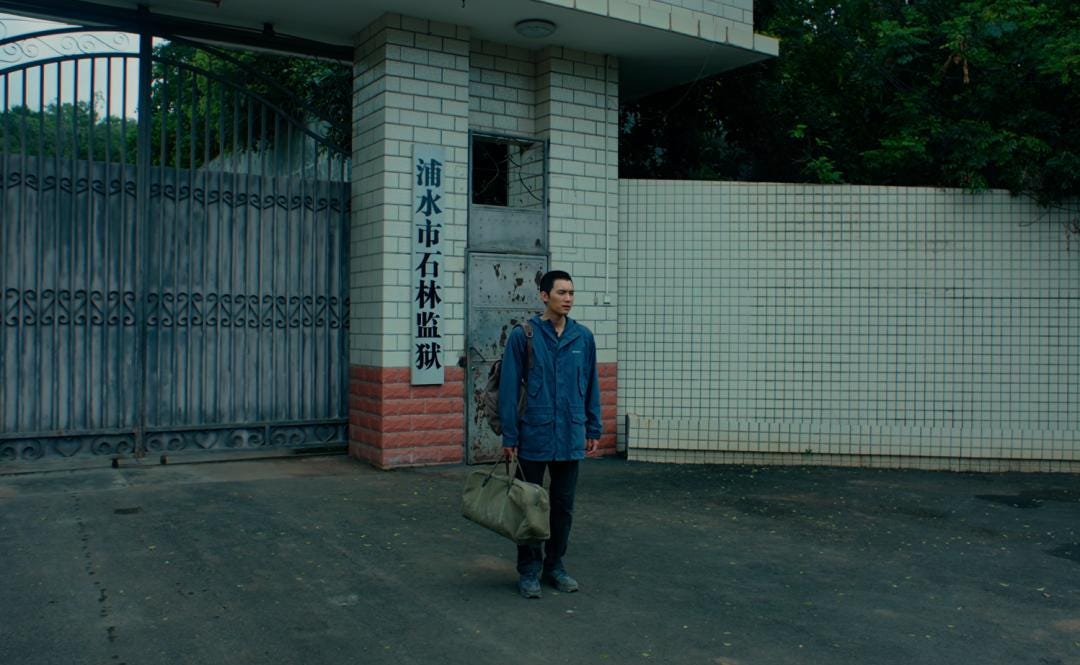
“They may not hire me. But what if they do?”
Over the past few days, Zhou Kai has repeatedly opened the mini-program of Pang Donglai Trading Group Co., Ltd. (“Pangdonglai”), a well-known retailer in Henan, and clicked into its recruitment page to see whether applications have opened. So far, the number of available positions has remained at zero.
On August 14, 2026, Pangdonglai announced that its planned Zhengzhou store would recruit 20 people who had completed prison sentences of five years or more, with a dedicated application channel set up for them.
The announcement quickly sparked debate online. Some saw it as much-needed help for formerly incarcerated people trying to reintegrate into society. Others questioned whether such a hiring policy was appropriate. One commenter put it bluntly: “I don’t want to be in danger when I’m shopping at a supermarket.”
This is not the first time Pangdonglai has recruited people released from prison. In August 2025, its Xinxiang store created a dedicated application channel for them. It initially planned to hire 20, but eventually took on 30.
Pangdonglai founder Yu Donglai later wrote on social media that none of those 30 employees hired in the first round had left after starting work.
The criteria have changed since that first recruitment drive. On August 19, 2026, Pangdonglai said it had gradually broadened eligibility from people convicted of relatively minor or moderate offenses to include some with more serious criminal records.
Southern Weekly reporters called Pangdonglai’s customer service line several times but were unable to get through.
“Too many people were trying to apply”
Zhou was in a good mood when he saw the recruitment announcement.
“But at the same time, I felt some regret,” he said. “Why wasn’t there an opportunity like this when I had just come out of prison and kept running into walls looking for work?”
In 2014, Zhou, then 23, was sentenced to seven years in prison for contract fraud. He was released on parole on September 10, 2019, after serving a total of five years and four months.
“Cashier, stocking shelves — I’m willing to do anything,” he said.
For Zhou, a job at Pangdonglai would be about as good an opportunity as he could hope for. Yu Donglai has said that the company’s employees earned an average of RMB 9,400 (about 1,400 U.S. dollars) a month in 2025.
Hao Wen, from Anyang in central China’s Henan Province, also called Pangdonglai’s customer service line when he saw this year’s announcement and said he wanted to apply. He was told to wait for further information.
A year earlier, he had missed his chance to apply for the Xinxiang recruitment.
“There were too many people trying to sign up. I couldn’t even get the application page in the mini-program to open.”
Hao had previously served three years and three months in prison for intentional injury and fraud.
After his release in 2023, a friend introduced him to a job at a branch of a listed medical-device sales company in a neighboring county. He was put in charge of business in the Inner Mongolia market. Management at the branch was relatively loose, and he was not required to provide a certificate of no criminal record when he joined.
In July 2025, strong performance earned Hao a promotion to regional manager. The head office, however, required a number of documents for the new position, including a certificate showing no criminal record. At the same time, the branch was being dissolved and its employees were to be transferred to headquarters.
Knowing he would not pass the company’s review, Hao resigned.
On August 10, 2025, Yu Donglai posted an explanation on social media about his decision to recruit people released from prison.
Hao described his reaction to reading it with one word: “shocked.”
Yu wrote that people who had broken the law, whether through a momentary mistake or other circumstances, had already received their punishment and were once again lawful citizens.
“We should help them reintegrate into society.”
“I cried my eyes out that night and drank a few bottles of beer,” Hao recalled.
He was moved that a company was willing to hire people with prison records. For the first time, he felt that he might have a chance too.
That evening, he bought what inmates at his prison used to call the “luxury trio,” food they would only get during holidays: pig’s head meat, garlic sausage and peanuts. He sat alone in front of the television as scenes from his time in prison replayed over and over in his mind.
After failing to apply online, Hao was not ready to give up. He took a high-speed train to Pangdonglai’s stores in Xinxiang and Xuchang.
“I thought maybe I might run into Brother Yu, or maybe they hadn’t received enough applicants like us.”
Neither happened.
Hao, now 38, habitually calls Yu Donglai “Brother Yu.”
“Brother Yu has been detained before too, so he understands us.”
According to the Dahe Daily, Yu published an internal letter on social media on November 9, 2025, that he had written to employees 22 years earlier. In it, he described some of the difficulties in his own past.
Years ago, Yu was detained after buying cigarettes of unclear origin and was later released on bail pending investigation. On another occasion, a friend riding Yu’s motorcycle was involved in a collision and assault, and Yu was also detained in connection with the incident.
Yu described these experiences as part of his “path to awakening,” which inspired him to “create a better environment and purify people’s hearts.”
On September 9, 2025, Hao wrote Pangdonglai a long letter online introducing himself and asking for a chance to interview.
Two days later, the company replied that applications had already closed.
“For this recruitment, we have done our utmost at every stage to ensure fairness,” the reply said. “Please believe in Pangdonglai’s sincerity!”
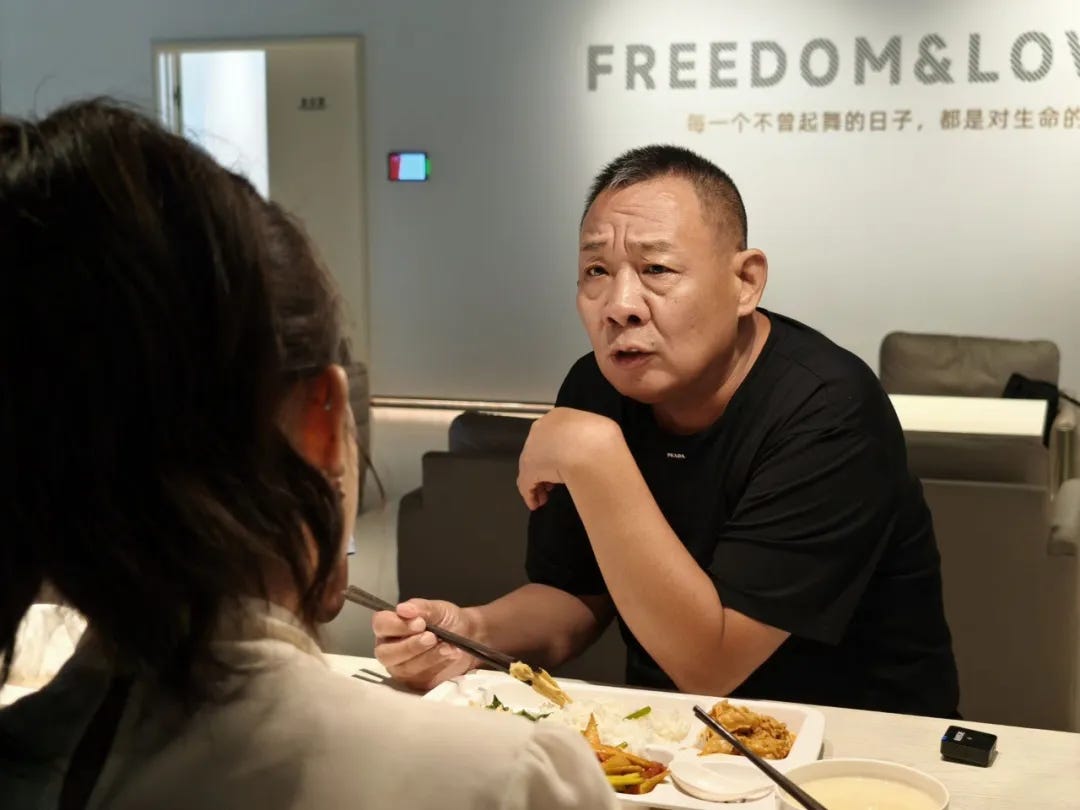
In August 2025, Yu Donglai gives an interview at Pangdonglai’s production base in Xuchang, Henan Province.
“I don’t want to be in danger when I’m shopping”
Zhou Kai wanted Pangdonglai to notice him.
He came up with an idea: leave comments under related posts on social media saying that he wanted a chance to apply.
Some users wished him well as he tried to return to a normal life.
Others immediately pushed back.
“Don’t rush to congratulate him. You don’t even know what crime he committed. You don’t get a five-year sentence for nothing.”
“Some people say, ‘If you’ve been to prison, why should you get such a good job?’” Zhou said.
He could see that both of Pangdonglai’s recruitment drives had generated considerable controversy online.
One view was that the company was giving people released from prison a chance to reintegrate into society. But another, more prominent concern was that a supermarket is a crowded public space, and hiring people with criminal records could make customers feel unsafe.
“I don’t want my life to be at risk when I’m shopping at a supermarket. Dangerous people are dangerous wherever they are.”
Southern Weekly found numerous comments expressing similar concerns under Pangdonglai’s official social media accounts.
According to a report by Jiangsu-based Litchi News on August 18, 2026, Pangdonglai responded to the criticism by stressing that its hiring policy was not unconditional.
People with records involving sexual offenses, severe violence and other particularly serious crimes would be excluded. Formerly incarcerated applicants would go through the same application and interview process as everyone else, followed by a six-month probation period in which both sides could decide whether the employment relationship was a good fit.
Members of the first group were also initially assigned primarily to warehouse, logistics and other back-of-house positions, an arrangement intended to balance employment assistance with safety concerns.
Zhang Jing, a law professor at Beijing University of Technology, has spent years researching the reintegration of people released from prison.
He said one argument has persisted in society for years: ordinary people already have difficulty finding jobs, so why should special positions be offered to people who have been in prison? Some go so far as to ask whether committing a crime can somehow earn someone a job.
“That is a confusion of logic,” Zhang said. “People released from prison have already completed the punishment prescribed by law. Under the Prison Law, once they leave prison they are equal citizens and enjoy an equal right to work and employment.”
Before leaving prison, Zhou had assumed that as long as he was willing to work hard, he would always be able to find some kind of job.
Reality proved different.
He tried food-delivery platforms, courier stations and garment factories in local industrial parks. Again and again, he ran into the same obstacle: employers wanted a certificate showing no criminal record.
In prison, Zhou had learned skills used in garment production, including fabric cutting and reading technical patterns.
“I filled out the employment form at a clothing factory. All they told me was, ‘Go home and wait for us to contact you.’ I never heard from them again.”
A 2026 paper by Wang Xiaojun, a senior police officer at Meizhou Prison in southwest China’s Sichuan Province, titled Exploring the Prevention of Reoffending Among People Released from Prison: An Empirical Study Based on One Prison and an Ecological-Theory Analysis (刑释人员重新犯罪预防之探索——基于某监狱的实证调研与生态理论分析), found a sharp tension between widespread discrimination against people released from prison and their need to reintegrate into society.
Among those surveyed, 70.89 percent said they were often rejected by companies and public institutions under various pretexts when applying for jobs.
Zhang added that social tolerance toward people with criminal records is, in practice, becoming more restrictive, as certificates of no criminal record are required in a growing number of situations.
Many people released from prison ultimately have to rely on their families or small private businesses to find work.
After repeatedly failing to get hired, Zhou’s family took out loans to help him start his own business.
He opened restaurants and karaoke clubs. At the height of his business, he operated four KTV venues at the same time, as well as a midsize restaurant capable of hosting banquets.
When he hired employees, he never asked whether they had criminal records.
Only later did Zhou learn that four or five of the young people he had employed had prior convictions. One had been convicted of negligent homicide. Another had a record for a sexual offense.
“I don’t keep digging into people’s pasts,” Zhou said. “I only care whether they work hard now. Everyone has been young once. We’ve already been punished.”
Zhou points to his own life as evidence that the price of making a mistake can last far beyond a prison sentence.
On the first day after his release, his wife asked for a divorce.
Later, he entered another relationship. Once the relationship became serious, he voluntarily told the woman’s family that he had served time in prison. The relationship ended soon afterward.
For years, Zhou could barely stand hearing the word “cheat,” even when someone jokingly said, “You cheated me.”
The label “contract fraud” was, to him, a stain he would never be able to wash away.
“I dreamed about prison again a couple of days ago.”
More than a hundred nights a year, Zhou said, he dreams about his time behind bars.
Even when his businesses were doing well, he remained deeply self-conscious. He became nervous whenever he met government officials.
“When I went to government meetings, I only dared sit on the edge of the sofa. I sat completely upright. I always felt that I should look obedient.”
Psychologically, Zhou says, he has never completely made it past that experience.
“Psychological recovery cannot be ignored either. A person has to feel, deep down, that society has still left them a way to live. Only then is there a real possibility that they can change their life.”
Pangdonglai’s 2026 recruitment statement made a similar point, calling on society not to discriminate against people released from prison.
Labeling and marginalizing them, the company said, can leave them unable to work or live normally, trapping them in pain and low self-esteem.
“That also creates an unhealthy and unhappy state for society as a whole.”
For Zhang Jing, Pangdonglai’s willingness to make jobs available to formerly incarcerated people is something worth encouraging.
“Employment is the most important foundation for preventing reoffending,” he said. “Only with a stable source of income can someone begin to rebuild a place for themselves in society.”

Pangdonglai’s first Zhengzhou store has not yet officially opened. On August 4, 2026, workers began installing glass panels for the building’s skylight.
“Goodwill alone cannot solve the problem at scale”
“If someone comes out of prison without financial or emotional support from their family, and the whole of society shuts the door on them, aren’t we effectively pushing some of them back onto the same old path?” Zhou asked.
During his years in prison, he saw people cycle in and out.
One inmate, a man in his fifties with a master’s degree, was unable to find a way to support himself after being released. He was arrested for stealing electric bicycles and returned to prison. After being released again, he committed another offense.
Zhang Jing told Southern Weekly about one of his former students.
The student had originally performed well at university, but a confrontation escalated and he was convicted of robbery and sentenced to three and a half years in prison.
After his release, he wanted to return to school, but his criminal record became an unavoidable barrier. He also repeatedly failed to find work.
The next time Zhang heard about him was years later, at a reunion.
“One of his classmates said he had turned up in Anhui and had become involved in a theft-related case. After that, we lost contact with him completely.”
Zhang also knew of a formerly incarcerated man who had nowhere to live after leaving prison and was rejected by his relatives.
He wandered along railway lines, surviving by collecting scrap. Unable to sustain himself, he eventually returned to stealing.
“There is an old saying that a prodigal son who turns back is worth more than gold,” Zhang said. “Society should allow these people to earn an income and build families of their own.”
In Zhang’s view, helping former prisoners return to ordinary life ultimately benefits society as a whole.
“Since the 1980s, scholars have repeatedly called for greater attention to employment and resettlement for people released from prison,” he said.
The way China has approached the issue has changed considerably over time.
In the early years after the founding of the People’s Republic of China, released prisoners were more often retained for employment at state-run farms or related facilities.
After reform and opening up, many labor-reform farms were gradually transformed into prisons, and policy shifted toward “retaining fewer and releasing more,” sending more people back into society after completing their sentences.
Following the restructuring of state-owned enterprises (SOE), SOEs largely stopped absorbing formerly incarcerated workers. Much of the responsibility for employing them shifted to private companies.
On August 12, 2025, Yu Donglai wrote on his personal social media account that Pangdonglai planned to introduce training programs to help people released from prison reintegrate into society, and that a support fund for this group would exceed RMB 10 million annually.
Other companies have also publicly recruited former prisoners.
According to New Rule of Law Daily, He Jian, head of Juesha Footwear Co. in Yichun, east China’s Jiangxi Province, had himself previously served time in prison.
In April 2024, He and three friends started a business and opened four factories. Nearly 30 percent of their almost 200 employees are people who have served prison sentences.
“But relying solely on compassionate individuals makes it very difficult to solve the problem at scale,” Zhang said.
Over the years, he has repeatedly tried to persuade companies to hire people released from prison.
Typically, he said, only one out of more than ten companies he approached would agree to take even a small number.
Businesses generally worry about potential risks, and there are few policy incentives to offset those concerns.
“Companies have no legal obligation to provide these jobs,” Zhang said. “Without tax breaks, subsidies or other policy support, most are unwilling to take on the additional risk.”
The employment problem, he argued, cannot simply be handed over to private businesses.
SOEs should play a leading role by example, while governments could use tax reductions, subsidies and both material and honorary incentives to encourage employers to participate.
Authorities could also support nonprofit organizations and improve transitional assistance services to strengthen the wider social-support system.
The COVID-19 pandemic eventually took a heavy toll on Zhou’s own businesses.
In 2023, his restaurant was forced to close, and his four karaoke clubs shut down one after another. Only one remains, barely staying afloat. Its monthly revenue is just enough to pay the wages of more than a dozen employees.
Zhou’s thinking has changed.
He now wants a stable job.
If Pangdonglai hires him, he says, he will move his entire family from Jiangsu to Zhengzhou.
At the end of his interview, he asked the Southern Weekly reporter:
“Do you think I have a chance of getting in? I really don’t have much experience with job hunting.”
Hao Wen, meanwhile, is also waiting.
“The exact recruitment conditions and positions haven’t been announced yet. I’m waiting too. If I meet the requirements, I’ll definitely apply.”
He is now back in his home county helping his parents run their clinic.
He is not as excited as he was the first time he tried to apply. If he is rejected, he says, he can accept that.
“No matter what happens, Pangdonglai recruiting people who have been in prison is a good thing for people like us.”
Some of you may have listened to the previous podcast episode of Inside the China Room with Jiang Jiang, in which I spoke with Professor Michael Jinghan Zeng, head of and a professor in the Department of Public and International Affairs at City University of Hong Kong, about his experience serving as Director of the Confucius Institute at Lancaster University in the UK.
Jinghan Zeng on the controversy and reality of Confucius Institutes and China–UK relations

This episode of Inside the China Room with Jiang Jiang, I’m joined by Professor Michael Jinghan Zeng from the Department of Public and International Affairs at City University of Hong Kong explore the controversies — and realities — surrounding Confucius Institutes and China–UK relations.
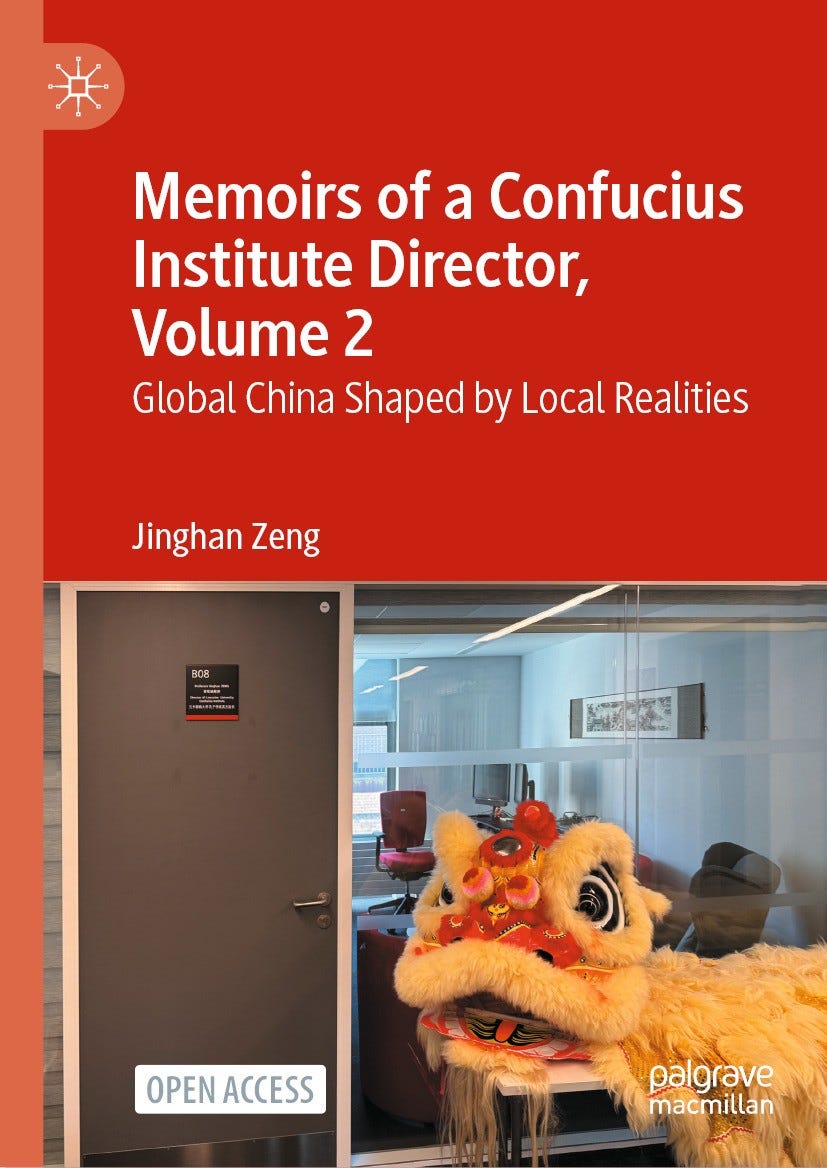
That episode has since become my most popular episode to date. Professor Zeng’s new book, Memoirs of a Confucius Institute Director, Volume 2: Global China Shaped by Local Realities, is now available for pre-order. If you’re interested in the subject, you can pre-order it through the link here. You can also download the open-access e-book for free through the same link.
The next episode of Inside the China Room with Jiang Jiang is also coming soon, so stay tuned.