

OPC, short for One-Person Company, has become one of China’s hottest startup concepts. The defining idea is simple: a single founder wielding AI as a force multiplier. It began gaining traction in the second half of last year and has become even more popular this year.
One important trigger was China’s OpenClaw craze earlier this year. OpenClaw, an open-source AI agent project that helps users build teams of AI assistants, caught on in China around February 2026 and soon spread beyond the tech community. Tencent Cloud and Alibaba Cloud began offering setup services for non-technical users, while short videos of people running their own AI agents flooded Chinese social media.
The excitement around OpenClaw helped popularize the idea that ordinary users could use AI not just as a chatbot, but as a working system for handling tasks, building products, and even running parts of a business. That broader shift helped prepare the ground for the OPC boom.
One interviewee told Southern Weekly that hiring an AI employee costs only 1.8% as much as employing a junior or mid-level software engineer. Earlier this year, OPC communities, a new type of startup incubator, began appearing across China. They offer entrepreneurs free or heavily subsidized office space, computing resources, startup mentoring, and even access to potential customers.
According to opcquan.com, the number of OPC communities nationwide grew from 95 to 618 during the first half of 2026, covering 24 provinces and 75 cities.
On June 18, 2026, seven central government departments jointly released an action plan for promoting collaboration between platform companies and businesses of different sizes. It marked the first time that “AI One-Person Companies (”人工智能一人公司”)” appeared in the main body of a national policy document.
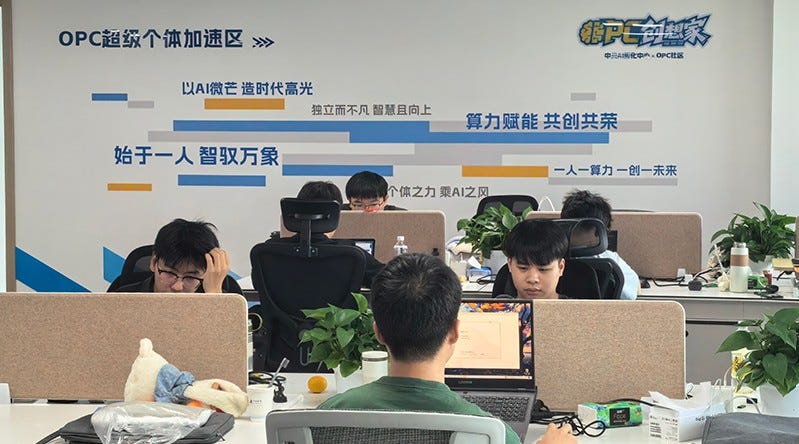
So how far has China’s OPC movement actually developed?
Below are five stories I compiled from three recent articles — one published by Bingdian Weekly, a WeChat publication affiliated with China Youth Daily; one by Southern Weekly; and another by the well-known Chinese technology and business WeChat blog Wuxiaobo Channel.
I think these stories not only illustrate the current state of China’s OPC ecosystem but also offer a glimpse into what life and work look like for today’s generation of AI entrepreneurs, how AI is reshaping businesses, and how it is changing the way people think about their careers. To make the stories easier to read, I’ve given each one a short theme.
Sun Shaocong: Patience Is Essential
Sun Shaocong is 39 years old. He spent 15 years at the China subsidiary of a leading European industrial electrical multinational, working his way up from intern to key account sales manager without ever changing employers.
In August 2025, his son was born. Three months later, in November, the open-source AI agent project OpenClaw was released. One Friday evening in early March 2026, Sun began asking AI for advice. His conversation with the model lasted 26 consecutive hours.
As he reflected on fifteen years of detailed and often tedious work processes, he decided to focus on helping traditional manufacturing industries undergo digital and AI transformation. Starting with a field he knew well — electrical component selection and quotation — he began building an AI assistant for the industrial electrical sector.
The idea was to break tasks such as searching specification tables, checking prices, verifying inventory, finding substitute parts, and preparing quotations into structured data, rules, and workflows, then let AI and software handle them collaboratively.
Three months into the business, he still had no revenue.
“We already have customers expressing clear purchase intentions,” he said, “but the product still needs more polishing.”
While registering his company, he discovered the Moshu OPC Community in Beijing’s Yizhuang National Innovation Park, located about 20 kilometers southeast of Tiananmen Square. The community officially opened in April 2026. Beijing now has twelve such OPC communities. By May 2026, there were already 426 OPC communities and related platforms nationwide.
These communities function almost like an outsourced team. They help entrepreneurs register companies while providing accounting, legal support, computing resources, AI tools, customer connections, project delivery assistance, and collaboration opportunities. Throughout Sun’s onboarding process, community staff coordinated nearly every step.
When a Southern Weekly reporter visited the Moshu OPC Community in mid-June, the coffee bar was already packed by 9 a.m.
Everyone was working alone. Some were pitching products remotely in English. Most were simply sitting behind laptops — quite possibly chatting with AI.
The community occupies around 3,000 square meters. On the exterior of its eight-story gray office building are slogans such as “Empowered by AI.”
Inside, the lobby continuously plays videos demonstrating how people use AI to increase productivity. The most prominent slogan reads: “The road to AGI: empowering more people through AI.” AI-related symbols cover nearly every wall.
Sun enjoys working there.
At the traditional company where he spent fifteen years, his customers, suppliers, and colleagues were mostly in their forties and fifties. Everyone worked toward the same organizational goals.
The OPC community feels entirely different. Most entrepreneurs are in their twenties, and almost everyone is building something different. His own company consists of little more than a single desk, focused on AI-driven digital transformation for industrial electrical manufacturing.
In the same workspace, one founder is building AI tools for children’s English education. Another is developing products around Feishu’s multi-dimensional spreadsheets. Others are working on children’s toys, automotive inspection equipment, or AI-generated video production.
They work in completely different industries, but they all rely heavily on AI.
At the moment, the Moshu OPC Community charges these entrepreneurs virtually nothing.
“As things stand, support from the industrial park has significantly reduced office and registration costs. The real cost isn’t money — it’s the time required for experimentation and learning.”
Wang Yubo: All the Pressure Falls on One Person
According to a report released in early April by Hangzhou’s Honghub OPC Community, one of China’s earliest OPC communities in Hangzhou, 75% of OPC founders come from non-technical backgrounds. The report identifies several common founder profiles: people leaving major tech companies, professionals applying years of industry expertise through AI, entrepreneurs who treat startups as a way of life, and campus geeks who see AI as the basic infrastructure for building a business.
Wang Yubo belongs to the first group.
She began learning the erhu, the traditional Chinese two-stringed instrument, at the age of six. Music eventually took her to performances on CCTV and overseas stages, where she played pieces such as Lake Baikal for foreign audiences. She also taught at a Confucius Institute. After more than twenty years immersed in traditional Chinese music, she knew exactly where learners struggled.
Erhu players typically read numbered musical notation, while many popular songs online are available only in staff notation. Converting between the two usually means paying someone to do the work and waiting at least a day. Otherwise, musicians must convert the scores themselves — a process that can take anywhere from half an hour to several hours.
That frustration became her business idea. She decided to build an AI-powered tool that converts staff notation into numbered notation. After using AI to create an early mini-program interface, she showed it to musician friends.
“They immediately told me, ‘Hurry up and build it. I want to use it,’” she recalled.
That was the moment she committed to the startup.
“The most important thing in running a one-person company is judgment,” she said.
But entrepreneurship also brought loneliness and uncertainty.
After spending two months training her model, she hit a technical roadblock.
“I couldn’t figure out how to convert printed sheet music into a digital format that AI could actually recognize.”
As the six-month trial period she had given herself approached its end, anxiety began to grow.
“I didn’t know whether I should keep going or start looking for a job.”
She began updating her résumé and was preparing to send out applications when, unexpectedly, the model finally worked.
“I gave AI answers that were close to being correct but still contained mistakes, and let it learn how to correct them. Gradually, it learned what ‘correct’ looked like.”
Starting with just a few bars of music, she expanded to several lines and eventually entire scores. That process took another two months.
“When nobody is supervising you, you have to supervise yourself.”
To force herself to finish, she set a launch deadline and promised friends early access to a beta version.
Then, in early February, she accidentally fractured a bone after missing a step.
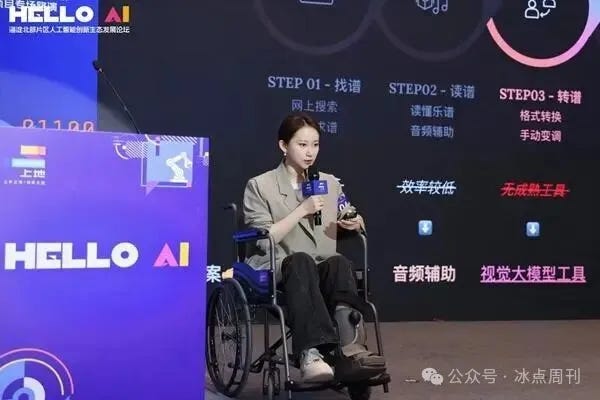
Even after breaking her leg, Wang continued working in front of her computer and attended investor roadshows on crutches.
As Wang Peng, an associate researcher at the Beijing Academy of Social Sciences, has written, the greatest strength of an OPC is also its greatest vulnerability. Because the business depends so heavily on the founder’s individual capabilities, poor decisions, health problems, or simple exhaustion can bring the entire company to a halt — a risk he describes as a “single point of failure.”
Behind that risk lies another challenge: the loneliness and fatigue of making every decision yourself.
“The pace is slow. Progress gets stuck. Everything falls on your shoulders.”
One entrepreneur quoted in the report described these periods as “moments of muscle weakness.” Another called them “the low-noise period” — times when there is little feedback from the outside world, while the mind remains full of doubt and constant internal dialogue.
That entrepreneur concluded that what ultimately helped was not emotional adjustment, but simply continuing to do concrete work — rebuilding confidence in the direction through steady action.
By late March, the beta version of Wang’s mini-program was finally ready.
Lu Yiwei: The Hidden Costs People Overlook
At a recent weekly project review at Hangzhou’s Future Digital Intelligence Port OPC Community, Lu Yiwei’s product — an AI-powered “viral article generator” — passed evaluation smoothly and became the highest-rated project of the day.
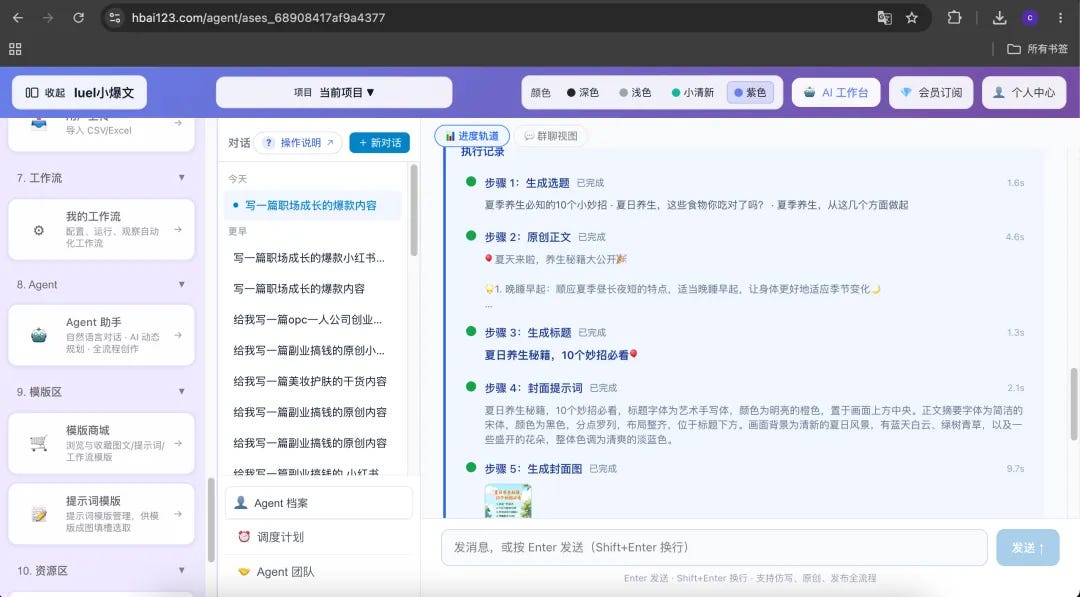
Lu’s “viral article generator” website
Lu is 43 years old.
Before starting his company, he was an executive at a small startup.
When ChatGPT appeared in 2023, it profoundly shocked him. As his employer struggled, he eventually resigned in early 2024 to launch his own business.
The transition proved much harder than expected. Without a technical background or experience building internet products, he failed twice.
His first attempt was an AI tool aggregation website with little technical value. Concluding that outsiders couldn’t build truly competitive products, he spent six months teaching himself AI programming from scratch before creating an AI emotional companion. He soon realized, however, that AI companionship might not represent genuine market demand, leaving the project with little commercial value.
So he started over again.
After another three months of development, he finally built his current product. Yet despite the enormous amount of effort invested, the website has generated less than 10,000 yuan (about 1,470 U.S. dollars) in revenue. After deducting AI token costs, the project has essentially earned nothing.
“The biggest cost of an OPC is time.”
After quitting his job, Lu gave up a stable annual salary of 600,000 yuan. His family now relies on savings, while expenses such as his children’s tuition and extracurricular activities continue regardless of whether the startup succeeds.
The family has reduced spending, cut back on everyday consumption, and moved into a smaller home.
At the same time, entrepreneurship has consumed virtually all of his time, with no clear financial return yet in sight. Since starting the company, he no longer separates work from leisure. Apart from occasionally spending time with his family, nearly every waking hour goes into the business.
AI employees also create hidden time costs. It took him three months to develop his product using AI programming, during which he rebuilt the entire system four separate times.
Each reconstruction required AI only a single day to generate the code, but beforehand he spent nearly a week carefully planning every detail. As projects become larger, AI grows increasingly prone to confusion and mistakes, forcing founders to spend much more time planning, supervising, and correcting its work.
Wang Jiahao: Is OPC a Bubble?
Wang Jiahao, a partner at Hangzhou’s Honghub OPC Community believes that nearly every successful Chinese internet and technology business over the past three decades followed the familiar Silicon Valley and Wall Street model of combining technology with venture capital.
Angel investment, rapid growth, equity financing, and lucrative exits formed the standard playbook.
“But in the AI era,” Wang said, “that playbook no longer works.”
The reason is straightforward. The traditional venture capital cycle — fundraising, investment, management, and exit — simply doesn’t apply in the same way to AI companies.
A team of three to five people can now accomplish work that previously required twenty employees. Their growth trajectory, asset structure, and valuation logic are fundamentally different from traditional technology firms.
But what actually makes an OPC worth investing in? Wang admits there is no longer an easy answer.
“It’s difficult to evaluate them using the simple financial metrics we relied on before. You have to consider market maturity, technological maturity, product completeness, and the founder’s own capabilities.”
Will OPCs eventually become profitable? Wang points to one striking figure: Silicon Valley companies collectively spend around $700 billion every year on AI infrastructure, yet AI currently generates less than $100 billion in annual revenue.
Meanwhile, the depreciation cycle for AI computing chips has shortened from six years to three years — or even less — creating enormous uncertainty.
On the other hand, AI adoption continues expanding rapidly, with annual growth rates of 300% or even 1,000%.
“So is it a bubble?” Wang asked.
“Not exactly.”
That question remains one of the biggest debates surrounding AI today.
Wang Zhijun: An OPC Deeply Embedded in the OPC Ecosystem
Thirty-year-old entrepreneur Wang Zhijun founded an OPC focused on NFC hardware combined with AI-powered marketing solutions. Earlier this year, she joined Hangzhou’s Future Digital Intelligence Port community.
Her company has only three people. She serves as CEO. Another founder — whose own OPC specializes in customized AI deployment — also serves as her CTO. A third partner, Wang Nuo, who is a judge at the project review meeting for the Hangzhou’s Future Digital Intelligence Port community, acts as her CFO.
The three of them have jointly established another OPC startup incubation platform that works closely with the Future Digital Intelligence Port community by evaluating new applicants and providing startup support.
This kind of cross-company collaboration is common within China’s OPC ecosystem. Founders frequently hold roles in one another’s companies, with the community itself serving as the platform connecting them. Entrepreneurs working in the same industrial park understand one another’s businesses and have already established a certain level of trust, making cooperation much easier.
Local governments and industrial parks each have their own incentives as well.
More than twenty Chinese cities have already introduced policies supporting OPC development.
For local governments, OPCs represent a relatively inexpensive way to bet on AI applications — a strategy built around deploying thousands of small entrepreneurial teams rather than competing at enormous cost to attract a handful of major technology companies.
For industrial parks operating OPC communities, the model also offers a way to revitalize underused commercial real estate.
Instead of relying solely on rent, an OPC community can theoretically generate income from four sources:
company registration and accounting services;
margins on bulk purchases of computing resources and foundation models;
revenue sharing from business referrals and larger projects;
returns from investing in startups located within the park.
This alignment of interests across multiple stakeholders has rapidly expanded the OPC ecosystem and is one of the reasons why the sector has become so popular.
Ultimately, successful business models are often surprisingly simple. From the moment Wang conceived her product to receiving her first order took only 45 days: An industrial park commissioned several hundred NFC wristbands that the OPC made to replace traditional paper brochures. When visitors tap the wristband, an information webpage and AI assistant automatically appear.
More recently, she secured another contract from a beverage company, embedding NFC chips into cup sleeves to create interactive experiences such as personality tests and product recommendations.
The interactive webpages behind these campaigns were all built using AI programming.
Final Thoughts
Starting a business has always been risky. AI startups face an even steeper challenge. A report released by MIT last year found that more than 95% of AI projects failed to achieve their expected return on investment, a failure rate significantly higher than in most other industries.
Yet this may also be the greatest significance of the OPC model. It brings both risk and reward back to ordinary individuals, giving people with ideas the opportunity to turn them into businesses. At the same time, it demands far more from each founder, who must develop deep industry knowledge while wearing many hats and navigating the full range of challenges that come with building a company alone.
In that sense, OPCs are not just a new form of company. They are also a new test of what one person can become with AI.
If you found this piece interesting, please click the like button. I’ll continue tracking developments in this space and share what I find in future newsletters.
A fascinating and informative report on the growth and potential pitfalls of AI and OPCs. You highlight the element of working alone and it is a very important one. Alienation is a well known condition of working practices worldwide and I can’t see AI diminishing the dangers not only to individuals but at a societal level. As China develops the model for successful working in collaboration internally and worldwide the threats to this are clear. Caution seems to be discarded in the race for AI dominance.
Once again Jing Jiang hits the proverbial nail on the head with this insightful article about OPCs, highlighting their dangers and opportunities. With China facing some economic headwinds, especially for young people, this piece should be a must-read for that cohort to ponder and engage in, while smoothing out its rough edges such as providing synergistic social contact with like minded people of several generations together creating new businesses where 1+1= >3. The Chinese are so achievement-oriented but have the same basic human needs we all do. Maybe OPCs are a new form of what President Xi has called "a community with a shared future for humanity". They certainly have the potential of being super-charged success stories.