

Computing power has emerged as one of the key themes in China’s technology policy this year. On October 16, Chinese President Xi Jinping visited Ulanqab in Inner Mongolia, home to one of China’s eight national computing hubs under the “East Data, West Computing” project.
According to Xinhua News Agency, Xi praised the rapid development of the region’s green computing industry but also warned against disorderly expansion and “involution-style” competition.
The visit came a week after the Communist Party of China (CPC) Central Committee and the State Council released guidelines calling for an integrated national computing network, one of the “six networks“ prioritized in China’s infrastructure plans.
On the same day as Xi’s visit, Qiushi, the flagship theoretical journal of the Communist Party of China, published an article by Liu Yunjie, a member of the Chinese Academy of Engineering and chief scientist at Purple Mountain Laboratories. Liu proposes what he calls a “high-speed rail for computing power”: a high-performance network connecting computing centers across China to allow them to work together more efficiently.
Established in 2018 as a major research platform jointly developed by Jiangsu Province and the city of Nanjing, Purple Mountain Laboratories focuses on future networks, advanced communications and cybersecurity. Its research aims to address strategic technological challenges and key bottlenecks facing China’s industries.
I think the article is worth reading not only for the technical challenges and potential solutions it discusses, but also for the strategic importance Liu attaches to the issue. Early in the piece, he places the development of such a network in the context of national security and digital sovereignty:
更为关键的是,算力关乎国家安全,一旦算力资源不能高效供给,人工智能产业、智能制造甚至国防安全都会受到制约。发展自主可控的“算力高铁”,是保障国家数字主权的战略需要,也是抓住人工智能发展机遇实现高质量发展的必然要求。
More fundamentally, computing power is a matter of national security. If computing resources cannot be supplied efficiently, the AI industry, smart manufacturing and even national defense will be constrained. Developing “high-speed rail for computing power” that we can build and control independently is a strategic necessity for protecting our digital sovereignty. It is also essential if we are to seize the opportunities AI presents and achieve high-quality development.
The article also does not shy away from the practical challenges China faces, including limitations in advanced chips, the geographical distribution and utilization of computing resources, and shortcomings in existing network infrastructure.
As for possible solutions, Liu explains why simply expanding computing capacity may not be enough, and how better networks could help China make more effective use of computing resources scattered across the country, particularly when access to advanced chips remains constrained.
He cites tests in which AI model training across sites 2,000 kilometers apart reached 98 percent of the efficiency achieved within a single-site cluster. These findings, as reported by Liu, offer a glimpse into how a leading Chinese network scientist is thinking about the country’s AI infrastructure strategy and the potential for networking technology to help address computing constraints.
Another part I found interesting is Liu’s discussion of developments in the European Union, Japan and the United States, where he highlights various initiatives to expand computing and network infrastructure. Given his standing in the field and the political significance of Qiushi, I think the examples he chooses are also worth noting for overseas observers. They provide some insight into which international developments a prominent Chinese specialist considers relevant to China’s own plans.
Another interesting part of the article is Liu’s vision for the network’s future expansion, both geographically and internationally. He proposes using advances in 6G and satellite internet technologies to extend the network beyond the ground into air, space and sea. He also envisions taking this “high-speed rail for computing power” overseas to support computing infrastructure development in Belt and Road partner countries and the Global South.
To me, this reflects a broader trend in China’s approach to major infrastructure projects: increasingly considering their potential reach and role on a global scale from the planning stage.
Below is my English translation of the article, originally published in Chinese in Qiushi, Issue 20, 2026.
Since some of the original Chinese paragraphs become quite long when translated into English, I have broken them up into shorter paragraphs for readability. I have also added bold emphasis to highlight passages I found particularly noteworthy.

Liu Yunjie
Building China’s “High-Speed Rail” for Computing Power
Liu Yunjie
Imagine “high-speed trains” running all around you, though you cannot see or touch them. Their unusual “passengers” are neither people nor freight, but computing power and data. Travelling at speed, these trains deliver their passengers to every destination safely, on time and efficiently. This is “high-speed rail for computing power”.
A new round of scientific and technological revolution and industrial transformation driven by AI is gathering pace. Computing power now provides a firm foundation for industries of every kind, playing a role comparable to water infrastructure in the agricultural age and electricity in the industrial age.
China’s high-speed rail system has become a globally recognised calling card for the country. Renowned for its speed, reliability, punctuality and extensive coverage, it represents China’s achievements in major engineering projects and its technological ingenuity.
Today, as computing power becomes central to the digital economy and AI reshapes global competition, we need to build efficient, reliable “high-speed rail for computing power” that reaches across the country. Like China’s railways, it should become a powerful national asset, supporting the high-quality development of our AI sector and securing a leading position in international competition in the years ahead.
“High-speed rail for computing power” is a metaphor for a high-performance network linking computing resources. If the computing centres scattered across the country are “stations”, this “digital high-speed rail network” connects every computing node and data node, as well as the organisations and individuals that use computing power.
Through a highly reliable, high-quality, high-speed network, it links providers of computing power and data with those who need them. Computing resources can then be allocated rapidly across regions, coordinated efficiently and accessed on demand, reaching every point of need safely, on time and efficiently, just like passengers on a high-speed train.
In February 2022, China launched the “East Data, West Computing” project to process data from the east using computing resources in the west. It has since established eight national computing hubs and ten national computing clusters across fourteen provinces, autonomous regions and centrally administered municipalities in eastern and western China.
The country’s total computing capacity now ranks second in the world. Yet the sheer scale of that capacity does not guarantee that we lead in how effectively it is used. What matters is getting it to work and putting it to good use.
Think of computing power as “freight” and the network as a “road”: if the road is blocked, even the best freight cannot get through. Experiments show that, on traditional networks, a packet loss rate above 0.5% reduces data transmission efficiency by 50%; above 1%, transmission efficiency falls almost to zero.
Packet loss is the percentage of all packets sent during a given period that fail to be transmitted successfully. Competition in computing power is therefore, at its core, also competition in network infrastructure.
More fundamentally, computing power is a matter of national security. If computing resources cannot be supplied efficiently, the AI industry, smart manufacturing and even national defense will be constrained. Developing “high-speed rail for computing power” that we can build and control independently is a strategic necessity for protecting our digital sovereignty. It is also essential if we are to seize the opportunities AI presents and achieve high-quality development.
China faces several practical obstacles in developing its computing capacity. We are still working our way up in advanced chips while also facing a technology blockade imposed from abroad. We therefore cannot simply replicate the West’s chip-led model of computing development; we need to find a different approach.
In the geographical distribution of resources, the performance of network transmission between computing centres in the east and west urgently needs to improve. We also need to increase the utilisation of green computing capacity in western China and enhance its practical impact.
As for the networks themselves, the traditional internet’s “best-effort” delivery mechanism is rather like an ordinary road frequently clogged with traffic. It struggles to provide the precision and efficiency that the AI age demands.
We can address these difficulties by “strengthening computing through networking” and “winning through strength in numbers”. When computing capacity at a single site is constrained, high-performance networks can pool dispersed computing resources from across the country for efficient coordination and unified scheduling. The idea is to use better networking to make up for shortfalls in computing power, integrating the nation’s resources into one immense supercomputer, or computing center.
Tests in China have shown that training large AI models across sites 2,000 kilometers apart can reach 98% of the efficiency of training within a cluster at a single site. This means that, with coordinated scheduling over high-performance networks, computing resources separated by thousands of kilometres can work almost as efficiently as if they were in the same server room, with very little computing performance lost. As technology continues to advance, pooling the country’s computing resources is an entirely achievable goal.
Around the world, major economies are accelerating the development of computing network infrastructure with unprecedented commitment.
In February 2025, the European Union launched an initiative to mobilise €200 billion for AI investment and build unified computing network infrastructure, directly supporting its strategic goal of becoming an “AI continent”.
Japan expects to quadruple the capacity of its backbone network by 2030 to support the integration of computing and networking and the widespread adoption of edge AI. This will allow devices close to data sources to run AI algorithms and models directly, providing essential support for applications such as the industrial internet, autonomous driving and smart cities to be deployed at scale.
In the United States, nationwide infrastructure for ESnet6, the sixth generation of the Department of Energy’s Energy Sciences Network, was built in 2022. It now connects more than fifty Department of Energy research sites, including the national laboratory system, scientific instruments, supercomputing facilities and other user facilities, as well as more than 270 research and commercial networks in five countries. Its primary purpose is to support computing and AI applications.
In 2023, the United States also began planning ESnet7, with twelve additional capabilities, including end-to-end deterministic performance and the ability to program and control resources across the entire network, positioning it as important infrastructure for AI development.
China has distinct advantages over other countries in developing “high-speed rail for computing power”. Our institutional system enables us to concentrate resources on major undertakings. This allows for top-level design, unified planning and coordination across regions for computing, network and energy infrastructure.
We have built network infrastructure that is both the world’s largest and at the forefront of technology, and we have complete industrial chains spanning all forty-one major industrial categories. The wealth of applications, including “AI + manufacturing” and “AI + energy”, creates an ecosystem for computing power that other countries struggle to match.
We also have a strong technological base. China has already achieved global leadership in next-generation networking technologies, including deterministic networking and optoelectronic integration. In March 2026, the Internet Engineering Task Force (IETF) accepted a draft technical standard on deterministic networking submitted by a Chinese team. Deterministic networking is also recognised as an important international standard for 6G. It is fair to say that deterministic networking has become an indispensable technical foundation for China’s “high-speed rail for computing power”.
Deterministic networking is a new form of network technology that guarantees the transmission performance of data flows. It ensures that data arrives at its destination within a specified time, with the reliability of a high-speed train running strictly to its timetable.
In China, deterministic networking based on optoelectronic integration has proved in practice to be an efficient way of delivering deterministic network services. It has achieved key performance targets: high bandwidth, at 400 Gbit/s per wavelength; high efficiency, with network utilisation above 90%; low jitter, or variation in delay, below 50 microseconds; low packet loss, at less than one packet in a million; and low costs, with network construction costs reduced by 60%. These capabilities provide essential technical support for closer integration between computing and networking.
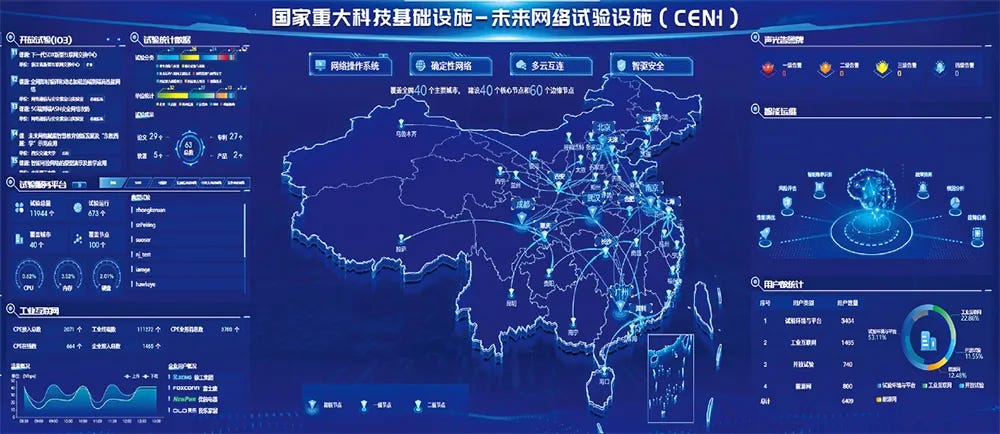
The China Environment for Network Innovations (CENI) is an experimental facility for future networks and China’s first major national science and technology infrastructure project in information and communications. It has built a secure new network with core nodes in forty cities across the country and 133 edge nodes. It has also established a centre for coordinating the scheduling of computing and network resources between eastern and western China, providing substantial support for the development of China’s “high-speed rail for computing power”. Pictured is CENI’s network management system, showing the facility’s wide-area deterministic network coverage. Image courtesy of the Jiangsu Future Networks Innovation Institute.
With the necessary technology now in place, how should we build China’s “high-speed rail for computing power”? The guiding principles should be high-speed interconnection, efficient resource scheduling, openness and inclusiveness, and security and reliability. We should first establish broad coverage across China’s large and medium-sized cities, then gradually extend the network to more regions, making its infrastructure accessible to all, just like China’s high-speed railways.
First, implement top-level plans. We must implement key national measures for connecting computing capacity to the network, bring computing centres across the country onto it, and accelerate the construction of an integrated national computing network.
Second, make full use of our scientific infrastructure. China Environment for Network Innovations (CENI), China’s first major national science and technology infrastructure project in information and communications, has already built a secure new network with core nodes in forty cities nationwide and 133 edge nodes. It has also established a centre for coordinating the scheduling of computing and network resources between eastern and western China. As we pool the nation’s computing resources, we should put facilities such as this to good use so that they better support high-quality AI development in China.
Third, encourage greater initiative from both telecoms operators and network equipment suppliers. The three major telecoms operators are the state-backed leaders and principal builders of China’s “high-speed rail for computing power”. Our many network equipment suppliers have underpinned our achievements in deterministic networking and optoelectronic integration. We should give these companies strong support as they expand their AI research, development and innovation efforts and take on a greater role in building “high-speed rail for computing power”.
Fourth, strengthen financial support. “High-speed rail for computing power” is a new field with vast development potential and a new foundation for China’s intelligent economy and society. With the country proposing to build “six networks”—water networks, new-type power grids, computing power networks, next-generation communication networks, urban underground pipeline networks and logistics networks—we should strengthen support from the financial system to provide firm backing for the sound and rapid development of “high-speed rail for computing power”.
The success of China’s high-speed railways grew out of forward planning, top-level design, independent innovation and deployment at scale. Building China’s “high-speed rail for computing power” calls for the same strategic resolve and systems thinking, ensuring that it continues to evolve towards greater openness, intelligence and security.
In technological terms, the network itself will become an intelligent agent built on a swarm-intelligence architecture. Control, operation and maintenance will be handled seamlessly in the background, with faults located and service restored within seconds.
Its reach will not be confined to the ground: the relevant technologies have already been applied to satellite internet. The next step will be to use the opportunities offered by 6G development to extend the network across air, space, land and sea.
Internationally, we can take “high-speed rail for computing power” overseas, support the development of computing capacity in Belt and Road partner countries and countries of the Global South, and share our computing resources and technological achievements with the world.
Building China’s “high-speed rail for computing power” is a vast infrastructure undertaking. Above all, it is a strategic initiative that will determine our country’s future competitiveness. Let us accelerate the construction of an integrated national computing network as we did with our high-speed railways, laying solid “digital tracks” for high-quality AI development in China.