

Good evening. Today’s piece features my English translation of an interview originally published on Dec. 16 on the Southern Weekly (南方周末) WeChat blog. The interview is based on an academic paper examining the work patterns of Chinese local officials, which was published in June this year in Public Management Review (《公共管理评论》).
Hosted by Tsinghua University, Public Management Review is a leading academic platform specializing in public administration and public policy. It was officially launched in December 2019, building on a continuous publication first established in 2004, and is currently issued quarterly.
Before you dive into the article, it may be helpful to clarify a basic institutional concept in China’s urban governance: the respective roles of a city’s Party secretary and mayor.
In China, the municipal Party secretary, as the top official of the Communist Party of China (CPC) at the city level, is responsible for setting the overall direction, ensuring policy consistency, and overseeing major strategic decisions in line with central and provincial requirements.
The mayor, as the head of the municipal government, focuses on day-to-day administration, economic and social development, and the implementation of policies and decisions. The two roles operate in close coordination, with the Party providing overall leadership and the government handling executive functions—together forming a governance framework designed to support effective decision-making, policy execution, and social stability.

What do prefecture-level party and government officials in China do every day? How do their priorities shift over the course of a term? And how do officials of different ages and career backgrounds behave differently?
These questions naturally intrigued 杨泽森 Yang Zesen, a scholar of political science and lecturer at the School of Public Administration, Jinan University, and 王心怡 Wang Xinyi, a PhD candidate in the Department of Political Science, School of Social Sciences, Tsinghua University.
By chance, while conducting separate research, they discovered a unique dataset from City A (a prefecture-level city anonymized for research purposes) in a central Chinese province. The dataset consists of official chronologies documenting the daily work, inspections, and official visits of the city’s Party secretary and mayor between 2010 and 2019. In total, it contains more than 7,000 individual duty records, amounting to over 2.73 million Chinese characters.
Based on an analysis of these data, the two scholars jointly published a paper in June 2025 titled 地方主官履职行为及其模式研究——对中部A市的长时段分析 “The Performance of Local Principal Officials and Its Patterns: A Long-Term Analysis of City A in Central China”, in the academic journal Public Administration Review (公共管理评论).
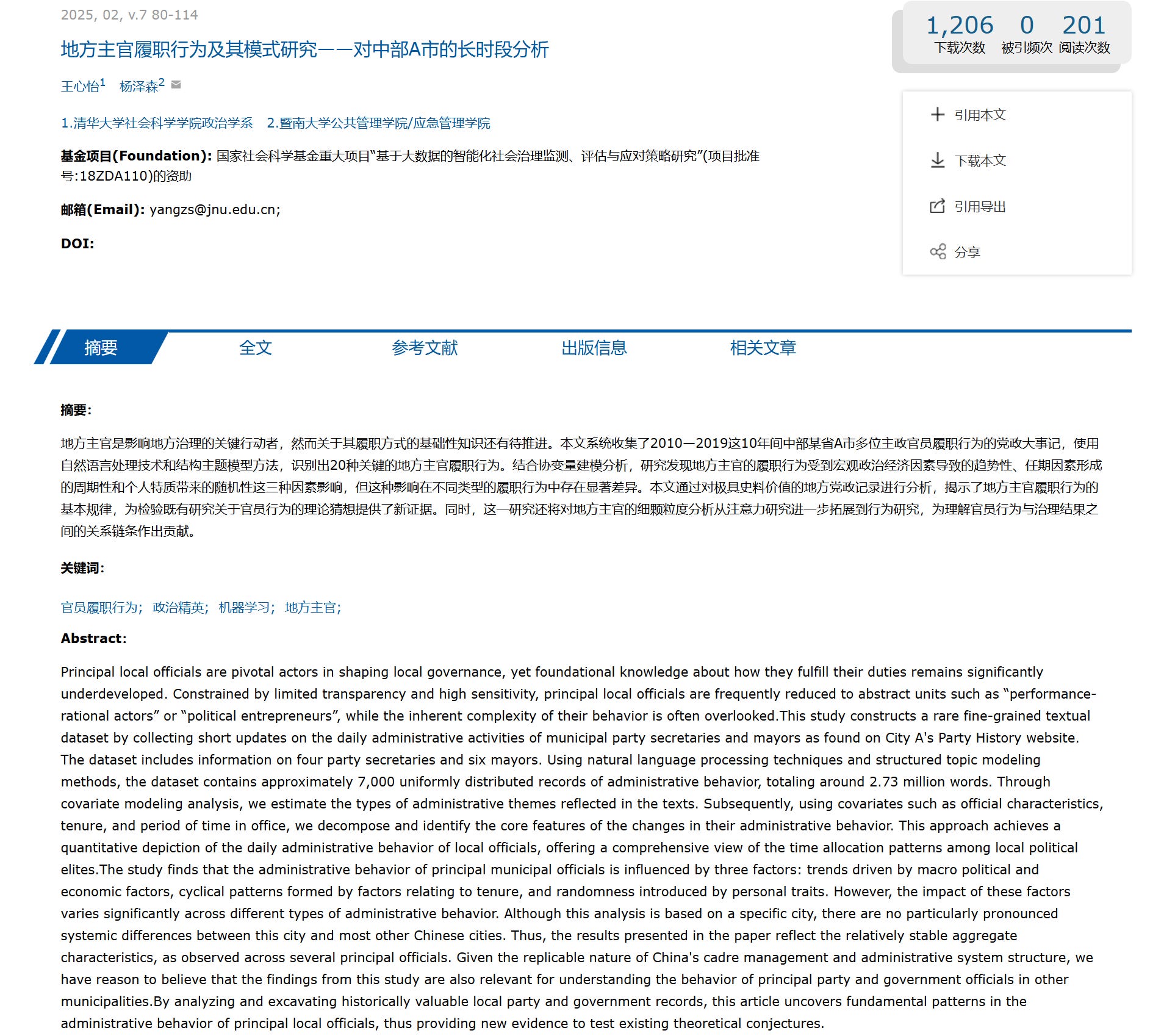
What follows is an interview between Southern Weekly (南方周末) and Yang Zesen.
1. “What Officials Pay Attention to” vs. “What Officials Actually Do”
Southern Weekly: How did you come across City A as a research sample?
Yang Zesen: It was purely coincidental. While working on another project, I needed to consult local government materials and came across City A’s chronicles of Party history events. Starting in July 2010, the Municipal Party Committee of City A regularly published, on a monthly basis, detailed chronologies of the daily official activities of the municipal Party secretary and the mayor, through the local Party history website.
These chronologies meticulously recorded activities such as inspections, research visits, and official trips. To my knowledge, this is the most detailed publicly available dataset documenting the behavior of local government officials that I have ever encountered.
Southern Weekly: There seems to be relatively little academic research on what local officials actually do on a day-to-day basis.
Yang Zesen: Over the past two to three decades, the most influential theory in Chinese political studies concerning officials has been the “promotion tournament theory”, proposed by scholars such as 周黎安 Zhou Li-An. The idea is that higher-level governments evaluate lower-level officials using comparative benchmarks, with performance—especially in promoting local economic growth—as the primary criterion. Officials who perform better are given greater promotion opportunities, creating a competitive environment.
From an empirical perspective, much of the literature focuses on how promotion incentives motivate officials to adopt policies that stimulate economic growth. However, there is a missing link in this chain. Incentives are directed at officials, while empirical studies often examine policy outcomes at the local government level. What lies in between—what officials actually do in their daily work—has largely remained a black box.
In recent years, many studies have shifted toward analyzing officials’ “attention”—that is, what issues officials focus on. Scholars typically infer this from officials’ written instructions (批示, pishi) or published speeches and articles. But what officials pay attention to and what they actually do every day are not the same thing.
Attention certainly matters because it influences policy implementation. But from the perspective of official performance (履职, lüzhí—the fulfillment of official duties), attention is only part of the story. Basic facts about what officials do in practice remain unclear. Senior officials receive dense media coverage, but for the much larger group of mid- and lower-level officials, systematic data are scarce. As a result, many studies rely on theoretical assumptions rather than direct behavioral evidence.
Southern Weekly: Can the City A chronologies be used to test these existing theoretical assumptions?
Yang Zesen: The main value of this study lies in the data themselves. We did not impose heavy theoretical modeling; instead, we focused on presenting factual changes in the behavior of local officials. Since there are already many hypotheses and conjectures, the most straightforward approach is to test them directly with data.
Our original motivation stemmed from basic questions: Are local officials’ behaviors largely pre-arranged? Do different individuals behave in the same way once they assume the role of principal local officials (地方主官)? Or do individual characteristics lead to systematically different behavior patterns?
Southern Weekly: How large is your sample?
Yang Zesen: We extracted all records from City A’s chronologies. Considering that the major public health event in 2020 (i.e., COVID-19) likely had a fundamental impact on officials’ behavior, we limited our analysis to the 2010–2019 period, covering a full decade.
The final dataset includes approximately 7,000 duty records involving four municipal Party secretaries and six mayors, totaling around 2.73 million characters.
Southern Weekly: From a macro political-economic perspective, what notable changes do you observe between 2010 and 2019?
Yang Zesen: In terms of political leadership activities, behaviors such as conveying and studying instructions and guiding principles from higher authorities (传达学习上级指示和精神) and implementing inspections conducted by higher-level authorities (落实上级巡视) became significantly more prominent over time.
For municipal Party secretaries in particular, implementing higher-level inspections emerged as a core duty. Activities such as receiving inspection teams, accompanying supervisory checks, and implementing rectification measures increasingly became high-frequency categories.
These trends corroborate a broader pattern since the 18th National Congress of the Communist Party of China (CPC) in 2012, whereby the central government has strengthened regulation and guidance over local governments through enhanced macro-level governance and oversight.
2. Different Priorities: Party Secretaries vs. Mayors
Southern Weekly: How did you categorize such a large volume of data?
Yang Zesen: We conducted a typological analysis of officials’ performance of duties. The behaviors of municipal Party secretaries and mayors were each classified into 20 categories.
Overall, the most frequent category for Party secretaries was “conveying and studying instructions and guiding principles from higher authorities.” This was followed by activities such as inspections and research visits, and providing guidance on urban development.
For mayors, the largest category was also “conveying and studying instructions and guiding principles from higher authorities,” but their remaining activities showed different emphases.
These differences reflect the division of responsibilities under unified leadership. Party secretaries tend to focus more on social governance (社会治理) and primary-level Party building (基层党建), while mayors place greater emphasis on urban development and economic construction.
Southern Weekly: How have economic policy-related activities changed over time?
Yang Zesen: Over time, four major categories—guiding urban construction, economic development, urbanization, and investment promotion (招商引资)—all showed a declining trend in proportional share for both Party secretaries and mayors.
This does not mean that the absolute number of such activities declined, but rather that their relative weight decreased. This suggests that under a more diversified performance evaluation system, local officials’ work has become more dispersed. Unlike in the past, officials can no longer focus almost exclusively on economic growth while devoting little attention to other areas.
Areas with markedly increased attention tend to be those subject to strong accountability mechanisms, such as environmental protection, which has become an increasingly important component of both Party secretaries’ and mayors’ duties.
Notably, Party secretaries have significantly increased their activities in social governance and public services, including guiding primary-level governance, visiting and consoling local residents (慰问群众), and overseeing agriculture and rural development.
Southern Weekly: What factors influence officials’ behavior, and how can they be analyzed?
Yang Zesen: Officials’ behavior is shaped by factors at three levels.
First, at the macro level, changes in political and economic conditions matter. From the perspective of local officials, this manifests in three ways:
1.Diversification of development goals: Whereas economic development once dominated, recent years have seen greater emphasis on social security and people’s livelihoods.
2.More comprehensive incentive mechanisms, combining both positive and negative incentives.
3.Central–local relations: As the central government strengthens top-level design, the extent to which this influences local officials’ behavior deserves careful examination.
In addition, two other factors matter: officials’ tenure and individual characteristics.
Because local officials do not know exactly when they will be promoted or transferred, they effectively operate under conditions of uncertain tenure. How do officials adjust their behavior under such uncertainty? One common hypothesis is that officials pursue large-scale construction projects early in their tenure—the so-called “three fires of a newly appointed official” (新官上任三把火)—to make their achievements visible as quickly as possible.
Southern Weekly: Does the same official behave very differently at different stages of their tenure?
Yang Zesen: Yes. We analyzed Party secretaries and mayors separately.
As their tenure progresses, Party secretaries tend to conduct more inspections and social engagement, focusing increasingly on primary-level governance, while reducing activities closely tied to economic growth, such as investment promotion and urban construction.
Mayors, by contrast, tend to intensify efforts in government reform, overseeing key projects and national-level new areas in the later stages of their tenure, while reducing inspection activities. In terms of urban construction, their behavior follows a “U-shaped” pattern—rising early, declining mid-term, and rising again toward the end.
Southern Weekly: Why do Party secretaries and mayors diverge in their priorities toward the end of a term?
Yang Zesen: This is related to changes in how officials are evaluated. Since the 18th CPC National Congress, evaluations have become more comprehensive, placing greater weight on people’s livelihood outcomes.
Moreover, Party secretaries and mayors operate under different incentive structures and divisions of labor. Party secretaries have stronger political responsibilities, and as their tenure lengthens, they increasingly focus on social governance.
For mayors, the U-shaped pattern in urban construction reflects strategic behavior. Officials often seek to accumulate visible achievements early on. If their accomplishments remain insufficiently recognized by the middle or later stages of their tenure, they may push for a new round of urbanization or construction initiatives toward the end.
3. Locally Promoted Officials vs. Officials Transferred from Elsewhere
Southern Weekly: You mentioned that individual characteristics also lead to differences in behavior. Could you elaborate?
Yang Zesen: We focused on two variables: age, a natural attribute, and official origin, meaning whether an official was locally promoted or transferred from another locality.
Age is a strong proxy for incentive intensity. Younger officials generally have greater promotion prospects and thus stronger incentives. As officials age, expectations of future promotion decline. Comparing officials across age groups helps reveal whether incentives shape behavior.
We found that Party secretaries and mayors aged 55 and above are significantly more active in environmental governance, while their involvement in urbanization projects is markedly lower than that of officials under 55. As retirement approaches, activities such as investment promotion, public outreach, and foreign affairs decline, and mayors also engage less in inter-regional cooperation and inspection visits.
There are also incentive differences between locally promoted officials and those transferred from elsewhere. Officials transferred from other regions are often appointed by higher-level authorities for specific purposes and tend to have more optimistic political prospects, exposing them to different incentive structures.
Our data show that externally transferred Party secretaries are significantly more active in investment promotion, conveying higher-level directives, and conducting inspections, but relatively less involved in environmental governance. Externally transferred mayors focus more on innovation and entrepreneurship and urbanization, while investing less effort in advancing government reform.
Southern Weekly: Did any findings exceed your expectations? What are your plans for future research?
Yang Zesen: This paper mainly confirms earlier conjectures, partially filling the research gap—or “black box”—between officials’ incentive motivations and government behavior. By offering a deep, localized analysis, it supplements existing knowledge. However, because the study is based on data from a single city, its conclusions are inevitably limited in scope.
After publication, scholars studying official attention contacted me to discuss integrating attention and behavior—for example, examining which policy issues officials focus on and which of those actually translate into concrete actions, and how the two relate. This is a promising direction for future research.