

One of the less visible aspects of China’s information ecosystem is the vast network of government-run accounts on WeChat blogs, the publishing platform built into WeChat.
Many central government agencies, such as the Ministry of Foreign Affairs, the Ministry of Commerce and the Ministry of State Security, operate accounts on WeChat to publish news, policy updates and official statements. Many foreign correspondents based in Beijing also follow these accounts as part of their daily reporting.
At the other end of the administrative hierarchy, however, thousands of counties, townships, subdistricts, villages and neighborhood communities in China have also established their own WeChat accounts.
Recently, Banyuetan (半月谈), a Xinhua-affiliated magazine published every two weeks, devoted an entire discussion to that seemingly simple question:
基层单位,有没有必要搞公众号?
Is it really necessary for grassroots governments to operate WeChat accounts?
Banyuetan assembled dozens of comments representing different viewpoints. Curious about where those comments came from, I contacted a colleague at the magazine, who told me they were submitted by ordinary Chinese internet users. Based on my own reading, many of the contributors appear to have first-hand familiarity with how China’s grassroots governments operate. The article concludes with a separate commentary from a township-level official.
Their observations, taken together, offer an interesting window into the everyday realities of local governance. For that reason, I think it is well worth reading — and I’d like to introduce it to you today.
Before diving into the debate, it is worth explaining what a WeChat account actually is.
Some people compare WeChat Official Accounts to Substack, and while the comparison is imperfect, it is not entirely unreasonable. Both allow organizations and individuals to publish articles and build subscriber communities. The difference is that WeChat is deeply embedded in everyday life in China in a way few platforms are elsewhere.
As one Substack article titled Why Every China Watcher Must Be on WeChat puts it:
“WeChat is not just another messaging app in China — it’s essentially the operating system for daily life.”
With more than 1.3 billion users worldwide, WeChat has become the default platform for communication, payments, government services, business networking and information distribution. As a result, a government department’s WeChat account is not simply another social media presence. It is often an important public-service channel.
To make the discussion easier to follow, I’ve lightly edited and reorganized the original text of Banyuantan’s post, removing repetitive comments and other material that doesn’t add much to the discussion, while preserving the substance of the original debate.
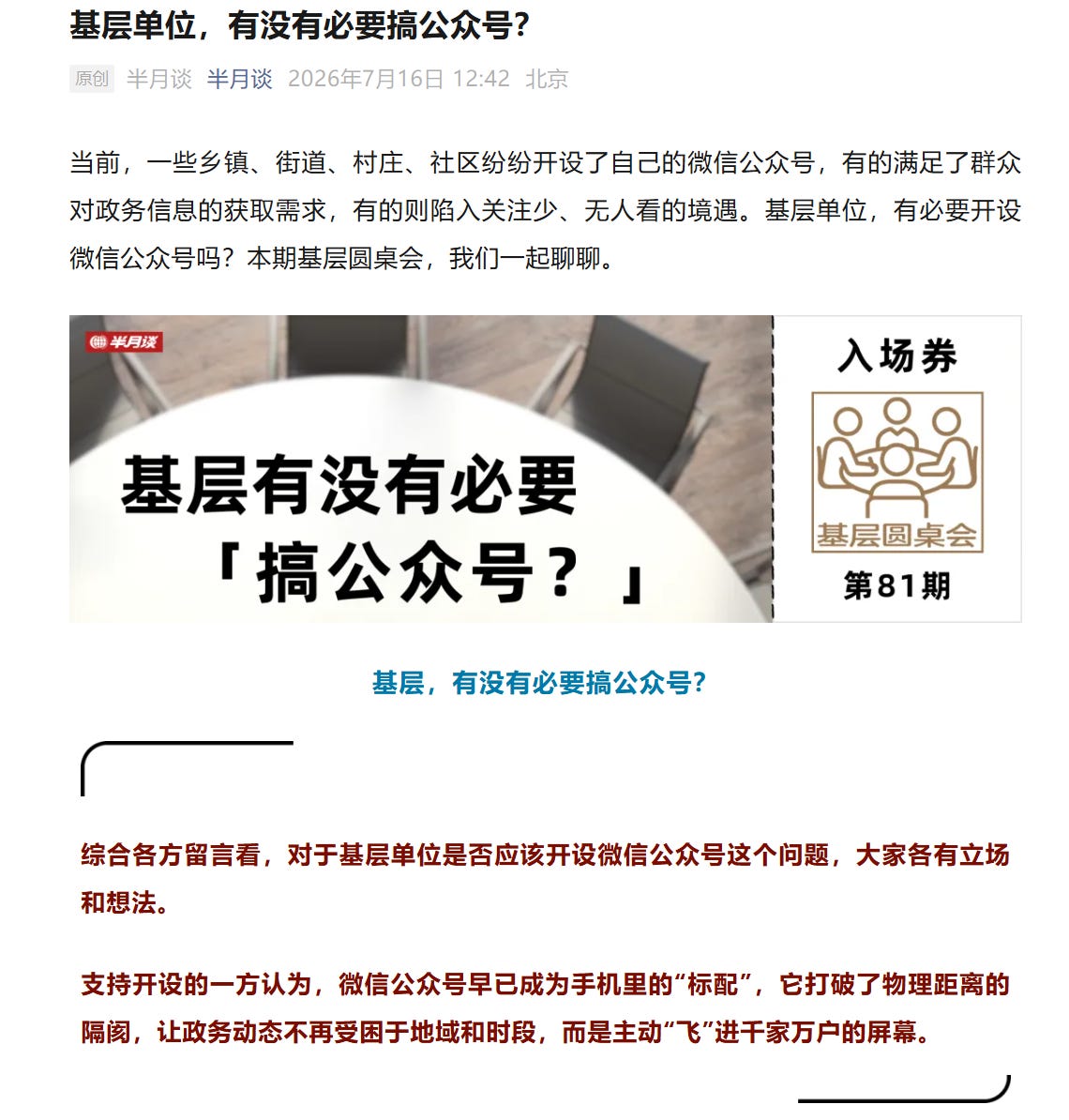
Title: Does every village in China really need a WeChat account?
The case for keeping them
Many commenters argued that WeChat accounts have become an indispensable tool for local governance.
One reader pointed to natural disasters: If flooding or another emergency occurs, an official account can rapidly notify residents, improving response speed and reducing confusion.
Another commenter described WeChat accounts as a “lightweight tool” for grassroots governance.
Compared with traditional notice boards or village loudspeakers, they can instantly deliver flood warnings, social insurance reminders, subsidy policies and administrative guidance directly to residents’ phones. They are particularly useful for migrant workers living away from home and younger residents who may no longer see offline announcements.
Others argued that official accounts also improve transparency.
By documenting how local officials perform their daily work, residents gain a clearer understanding of what township governments actually do. Good governance practices developed in one township can also be shared with others facing similar challenges.
Not every place needs one
Many readers agreed that WeChat can be useful — but rejected the idea that every locality should have its own account.
One commenter argued that densely populated urban communities and larger townships, where residents rely heavily on online public services, should continue operating official accounts.
Remote villages experiencing population decline, where most remaining residents are elderly, have far less need for one.
Another reader suggested that many villages are simply too small.
Rather than maintaining a separate public account, a village WeChat group — where each household is represented — may already meet most administrative needs while imposing far less work on local officials.
Several commenters also noted that township governments, unlike individual villages, often serve much larger populations and therefore benefit more from maintaining centralized public accounts.
When digital governance becomes digital paperwork
The discussion became particularly lively when readers turned to the downsides.
Many argued that some government accounts have gradually lost sight of their original purpose.
Instead of providing practical public services, they have become collections of routine work reports: which leaders inspected which village, which meetings were held, which delegations visited.
As one commenter observed:
Residents trying to find information about medical insurance or government subsidies often have to scroll through endless reports about official meetings before finding what they actually need.
Others argued that these accounts sometimes become tools for internal performance assessment rather than public communication.
Although readership may be low, local governments are still expected to update them frequently, with metrics such as reposts and engagement sometimes becoming part of bureaucratic evaluation.
One commenter described the phenomenon as a form of “digital formalism” (指尖形式主义) — the practice of maintaining an online trail merely to demonstrate that work has been done. In this respect, the Party-wide study and education campaign on establishing and practicing a correct view on governance performance appears particularly relevant, as it also seeks to curb the tendency to prioritize visible outputs and bureaucratic box-ticking over concrete results.
The burden on grassroots officials
The strongest criticisms came from people with first-hand experience operating these accounts.
A former township editor recalled spending countless late nights writing articles after completing regular government work.
Without dedicated staff, maintaining a WeChat account simply became another responsibility added to an already overloaded workload.
Another commenter explained that many township accounts are run by one or two part-time employees responsible for photography, writing, editing and page design.
After investing hours producing a carefully edited article, readership often reaches only several dozen — or at most a few hundred — people.
Meanwhile, they still have to monitor comments, respond to public feedback and continue updating during weekends and public holidays.
One former publicity officer described how every township was expected to publish similar holiday activities because neighboring townships were doing the same. Higher authorities also assigned monthly promotion targets, leading staff to stage promotional photos simply to satisfy reporting requirements.
Looking back, the commenter concluded that much of the work amounted to formalism — generating visible activity without creating corresponding public value.
So what should be done?
Most suggestions did not call for eliminating WeChat accounts altogether.
Instead, readers advocated making them fewer, more practical and more responsive.
Several proposed consolidating village-level accounts into township-level platforms instead of having every village maintain its own.
Others argued that performance indicators should shift away from counting likes, reposts or publication frequency, and instead focus on whether residents’ problems are actually solved and whether policies reach the people they are intended to serve.
Perhaps the most thoughtful suggestion came from a commenter who argued that government communication should move from one-way publicity toward two-way public service.
Official accounts, the commenter wrote, should focus on explaining policies, providing public services and responding to citizens’ concerns — not documenting leaders’ meetings or internal administrative activities.
A grassroots official weighs in
The article concludes with a commentary from He Muran, an official with the Organization Department of the CPC county committee of Daocheng County in Sichuan Province.
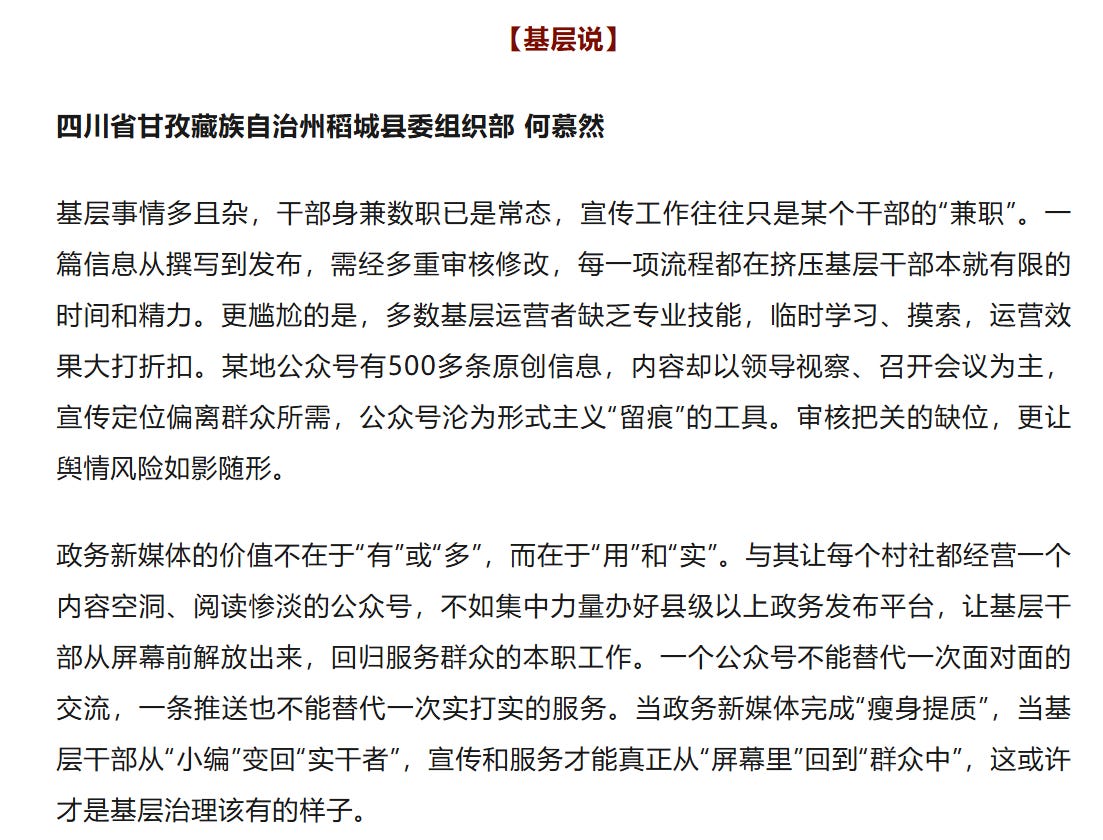
He notes that grassroots officials routinely juggle multiple responsibilities, with publicity work usually assigned as a part-time task. Every article must pass through multiple rounds of review and revision, consuming time that could otherwise be spent serving residents directly.
Many operators also lack professional communications training, while some accounts accumulate hundreds of original posts dominated by inspections and meetings rather than information useful to ordinary citizens.
His conclusion is striking:
政务新媒体的价值不在于“有”或“多”,而在于“用”和“实”。
The value of government new media lies not in how many accounts exist, but in whether they are genuinely useful.
Rather than requiring every village to maintain an underused account, he argues, governments should concentrate resources on stronger county-level platforms while allowing grassroots officials to return to face-to-face public service.
His closing observation captures the broader spirit of the discussion:
一个公众号不能替代一次面对面的交流,一条推送也不能替代一次实打实的服务。当政务新媒体完成“瘦身提质”,当基层干部从“小编”变回“实干者”,宣传和服务才能真正从“屏幕里”回到“群众中”,这或许才是基层治理该有的样子。
A WeChat account cannot replace a face-to-face conversation. A social media post cannot substitute for real public service. When government communication becomes leaner and more practical, grassroots officials can spend less time managing screens—and more time serving people.
For outside observers, the debate itself may be just as interesting as its conclusion.
Rather than presenting a single official position, Banyuetan chose to showcase a broad range of views —including criticisms of bureaucratic formalism, digital performance metrics and unnecessary administrative burdens. Whether one agrees with every comment or not, the discussion provides a rare, bottom-up snapshot of how questions about digital governance are being debated within China’s own public discourse.
I’m curious how governments in your country use social media to engage with the public. Are there any practices you think work particularly well—or lessons worth learning from? Feel free to share your thoughts in the comments.
As always, a very insightful look into the more subtle aspects of real life in China. Thanks!