

Good afternoon. Today is the final day of Q3 2026, and one of the most important developments over the past week was the latest China-U.S. summit in Washington.
Today, I want to share an interview published on Monday by the Chinese magazine Caijing 《财经》with Wu Xinbo, dean of the Institute of International Studies of Fudan University and director of the Center for American Studies at Fudan University. Wu is widely regarded as one of China’s leading scholars on the United States, and I think his reading of the latest China-U.S. summit is worth attention.
According to Foreign Minister Wang Yi, an important political outcome of the visit is that President Xi and President Trump further enriched the substance of the new positioning of China-U.S. relations and have agreed to build a constructive China-U.S. relationship of strategic stability based on respect, fairness and reciprocity.
The meeting was also preceded by a new round of economic and trade talks in New York and Washington. China’s Ministry of Commerce said the discussions produced progress on several fronts, including reaching an arrangement to reciprocally reduce tariffs on about $30 billion worth of goods from each side, with tariffs on around 90 percent of products covered to be lowered to most-favored-nation rates.
I also want to briefly flag another topic I have been following: the growing number of overseas business and study groups coming to China to look at advanced industries firsthand. China Central Television recently reported on the trend under the theme “Come to China to See the Future.” I will return to this at the end of today’s newsletter with details on upcoming tours organized by Baiguan, whose CEO Robert Wu was a previous guest on my podcast.
Caijing’s Interview with Prof. Wu Xinbo
1.What the new positioning of China-U.S. relations means
Caijing: The Chinese and U.S. presidents exchanged visits within less than half a year, something unprecedented in the history of bilateral relations. How would you assess the significance of Xi Jinping’s latest U.S. visit for China-U.S. relations? What was the most important signal it sent?
Wu Xinbo: The main significance of the visit was that it carried forward efforts to build a relationship of constructive strategic stability between China and the United States and seized the opportunity to achieve further progress while maintaining stability.
It was a successful visit. The clearest signal was that both countries want greater stability, more cooperation and more exchanges, along with more effective management of differences and regulation of competition.
Caijing: China and the United States reached eight deliverables and understandings during the visit. The first was an agreement to build “a China-U.S. relationship of constructive strategic stability based on respect, fairness and reciprocity.” Compared with the formulation of “constructive strategic stability” put forward in May, what new meaning does this wording carry?
Wu Xinbo: During China-U.S. economic and trade negotiations last year, China said the relationship should be handled in a spirit of equality, respect and mutual benefit.
When President Xi and President Trump met in May this year, China outlined what constructive strategic stability should involve: cooperation as the main theme, competition within limits, differences kept under control, and peace within reach. The U.S. side later put forward the concepts of fairness and reciprocity.
During the Washington meeting, the two countries held in-depth discussions on what constructive strategic stability should mean. They eventually reached a principled consensus around three concepts: respect, fairness and reciprocity. This formulation incorporates positions from both sides.
The fact that China and the United States could reach further agreement on the substance of a constructive strategic stability relationship shows that both sides are serious about this new vision. It also provides clearer guidelines and principles for handling bilateral relations going forward.
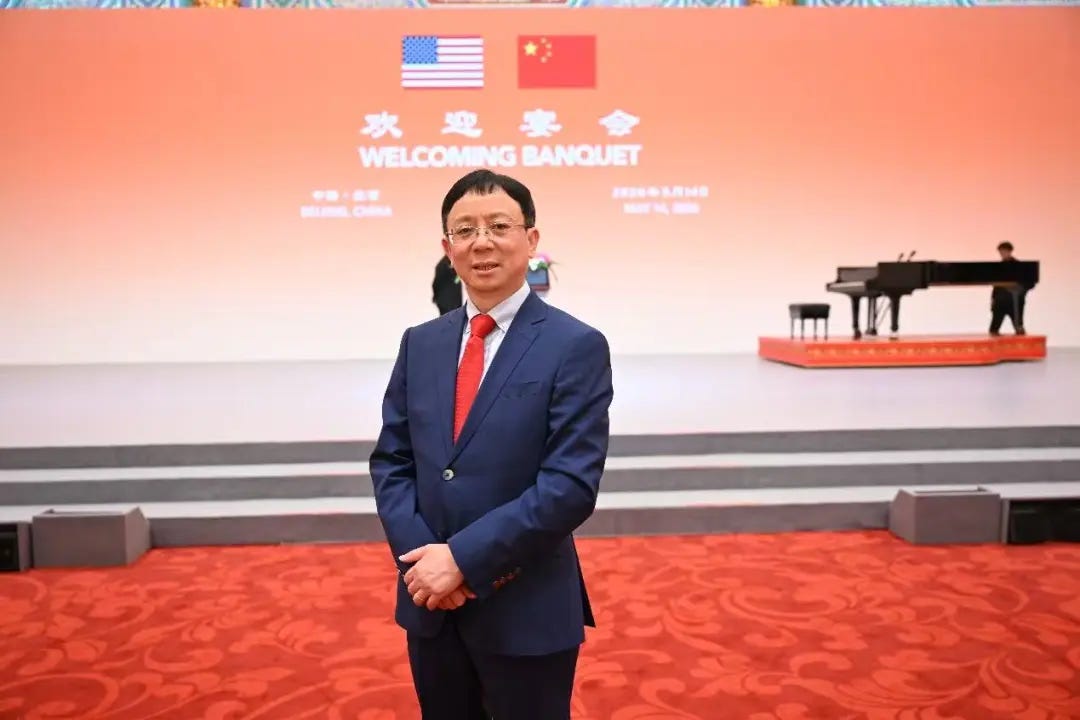
Caijing: You attended the welcome banquet for President Trump in Beijing in May. Between that visit and the latest presidential meeting, what changes have you seen in the overall atmosphere of China-U.S. relations?
Wu Xinbo: China-U.S. relations have become more stable overall since May.
Mutual trust has improved to some degree. Differences are being managed more effectively, friction has eased somewhat, and the scope for cooperation has expanded.
Caijing: In his remarks at the White House welcoming ceremony, Xi Jinping said the “Thucydides Trap” can be avoided. If China and the United States are to avoid the Thucydides Trap and build a relationship different from the traditional pattern of major-power rivalry, what institutional arrangements are most important?
Wu Xinbo: Institutionally, avoiding the Thucydides Trap requires more high-level strategic interaction between China and the United States.
That can strengthen political trust, expand common ground, advance cooperation, reduce miscalculation, and lower the risk of friction and conflict.
This includes regular leader-level diplomacy, dialogue and communication in political, diplomatic and strategic fields, military-to-military exchanges, and high-level economic and trade consultations.
2.Two challenges for economic and trade talks
Caijing: Since becoming Chinese president in 2013, Xi Jinping has visited the United States six times. Looking back over the past 13 years, how has the China-U.S. relationship changed? Compared with previous presidential meetings, what major changes have taken place in the wider international environment and the broader context of bilateral relations?
Wu Xinbo: It has been 13 years since Xi Jinping first visited the United States as Chinese president in 2013 and met then-U.S. President Barack Obama at the Annenberg estate.
Over that period, the relationship has undergone a major shift. The turning point came mainly during Trump’s first term, when the United States identified China as its primary strategic competitor and recast its China policy around strategic competition.
There are two major differences between the backdrop to this visit and that of earlier meetings.
The first concerns the bilateral relationship itself. After a decade of U.S. containment, China has not been weakened. It has become stronger and more confident, with greater experience and more resources in dealing with the United States. China’s position in bilateral interactions has therefore improved significantly.
The second concerns the international environment. The United States is now in a relatively unfavorable position, and its international standing and influence have declined.
The conflict in the Middle East and the Russia-Ukraine conflict have absorbed a great deal of U.S. resources and attention. U.S. strategic retrenchment has become more apparent, with Washington putting greater emphasis on the Western Hemisphere rather than expanding globally to reinforce its dominant position.
Relations between the United States and its allies have also weakened noticeably, and its alliance system is showing stronger centrifugal tendencies. This is part of the environment Washington now faces.
China, by contrast, has seen its international standing and influence rise markedly. The competitiveness of its economy and its weight in the global economy have both increased.
Diplomatically, China has continued to promote multilateralism and cooperation on global governance and to strengthen ties with countries in the Global South. These developments have also increased its international standing and influence.
In a sense, the international positions of China and the United States are now moving in opposite directions.
Caijing: Trade and tariffs remain major issues in the relationship. The two countries have agreed to extend the trade truce until January 10 next year. What are the hardest issues in the current negotiations? And does the launch of the Trade Council and Investment Council suggest that China-U.S. economic and trade consultations are moving beyond short-term dispute management toward more regular and institutionalized communication?
Wu Xinbo: Two issues are especially difficult.
One is U.S. containment and pressure on China in the technology sector, including export controls and sanctions on Chinese companies.
The other is restrictions on Chinese investment and the tendency in the United States to apply national security considerations to an expanding range of economic issues.
Since China and the United States agreed in May to establish a Trade Council and an Investment Council, the Trade Council has started operating and produced concrete results. There has been little movement on the Investment Council.
Going forward, China and the United States need both high-level economic and trade consultations and more regular, institutionalized work through these two councils.
Their progress is likely to differ. We are likely to continue seeing movement on trade. Investment will be more difficult because there remains strong domestic opposition in the United States to easing restrictions on Chinese investment.
Caijing: China and the United States have agreed to establish an AI dialogue to discuss the risks and benefits of artificial intelligence. What should the mechanism focus on first? Where do the two countries have common ground, and where do they differ?
Wu Xinbo: China and the United States have agreed to establish a notification mechanism for AI-related security risks. If either side encounters or anticipates risks arising from artificial intelligence, it will notify the other in a timely manner.
The China-U.S. AI dialogue should focus mainly on identifying risks and finding effective ways to manage them.
At the same time, even as the United States talks with China about managing AI risks, it will continue trying to constrain China’s AI development in order to preserve its own leading position in the field.
3.Guardrails for a stable China-U.S. relationship
Caijing: China-U.S. competition now extends beyond traditional trade into technology, artificial intelligence, supply chains and other fields. If competition is unavoidable, how can the two sides define its boundaries and prevent it from turning into confrontation?
Wu Xinbo: The boundaries of competition are not something that can simply be negotiated. They are defined through interaction and contestation in practice.
They are also dynamic rather than fixed.
In technology, the United States has sought to constrain China. But as China makes technological progress, the scope of those restrictions will retreat and narrow.
Take advanced chips. As China continues to make progress, the United States will ease some of its restrictions on chips to China. The same applies to artificial intelligence. As China advances, the scope of U.S. restrictions and pressure will shrink.
The same dynamic can be seen in supply chains. When the United States finds that it still depends on China in important areas, it will not decouple and will continue relying on Chinese supply chains. China, of course, also depends on U.S. supply chains in certain areas.
One further point is important. When we say competition should remain within limits, we mean it needs to be managed so that it does not spiral out of control and become confrontation.
That does not mean confrontation will never happen. In reality, it happens frequently. Sometimes it is only after a period of confrontation that the two sides find a new boundary and a new equilibrium.
Caijing: Where does practical room for China-U.S. cooperation still exist? Can cooperation in these areas serve as guardrails for the broader relationship?
Wu Xinbo: There are still quite a few areas where the two countries can cooperate.
The first is economic and trade relations. The shift from intense economic confrontation last year to relative stability today shows that neither country can simply do without the other. This remains the most practical area for cooperation.
Law enforcement is another. U.S. concerns over fentanyl require Chinese cooperation, but the two countries also need to work together against transnational crimes such as online fraud and crimes targeting women and children. They are already conducting effective cooperation in these areas.
There also needs to be more dialogue, exchanges, communication and cooperation on AI safety risks.
And on some major international and regional hotspot issues, the United States also needs China’s cooperation, including the U.S.-Iran conflict, the Russia-Ukraine conflict and the Korean Peninsula.
Communication, coordination and cooperation in these areas help stabilize China-U.S. relations. In that sense, they also serve as important guardrails for the relationship.
Caijing: The United States will hold midterm elections in November. How might the elections affect the Trump administration’s China policy? And how are American perceptions of China changing? Is this mainly a response to short-term political factors, or could it point to a longer-term trend?
Wu Xinbo: The midterm elections may weaken Trump politically to some extent. That could expose him to greater domestic pressure on China-related issues and lead him to pull back on some positions. We need to be prepared for that.
American perceptions of China have changed over the past two years.
At the societal level, more people have become aware of China’s development and progress, as well as its achievements in governance.
Some informed voices in the United States have also come to believe that efforts to contain and pressure China in recent years have not worked very well. They have neither weakened China nor stopped its progress. In some respects, they have accelerated China’s push for indigenous innovation and contributed to breakthroughs in key fields.
That has led some people to argue for selective openness toward China, including welcoming Chinese investment in electric vehicle manufacturing in the United States and making use of advanced Chinese technologies to improve U.S. EV manufacturing capabilities.
Whether this change in American perceptions of China proves temporary or lasting depends primarily on China itself.
If China continues to develop well, grow rapidly and govern effectively, then in the face of those facts, most Americans will eventually have to revise their biases toward China and form a more objective and more positive view of the country. Some U.S. opinion polls are already showing signs of this.
So in my view, whether American perceptions change, and how they change, depends fundamentally on China’s own development and governance.
Caijing: Looking ahead over the next three years and beyond, how do you see the prospects for China-U.S. relations? What are the most likely characteristics of the relationship, and how are competition, cooperation and interdependence likely to coexist?
Wu Xinbo: Over the medium to long term, I think the broad trend toward stability in China-U.S. relations can largely continue, and practical cooperation can increase.
There will, of course, still be struggles and friction, and even conflict in some areas. But overall, these can be managed.
China’s position in its dealings with the United States will continue to improve, and the United States is likely to become somewhat more pragmatic in its approach to China. At the same time, uncertainty in China-U.S. relations will remain.
Overall, I expect the relationship to remain broadly stable on the basis of the current situation, with the two countries pursuing practical cooperation and managing their differences.
A separate note on China industry tours
One other trend worth watching is the growing number of overseas executives, investors and study groups coming to China to look at advanced industries firsthand.
China Central Television recently ran a report on this trend under the theme “Come to China to See the Future.” featuring, among others, an industry study tour organized by Baiguan, whose CEO Robert Wu was a previous guest on my podcast.
What makes these tours useful is that they go beyond conference-room briefings. Participants can visit smart factories, AI labs and supply chain hubs, and speak directly with company executives. For people trying to understand China’s AI, manufacturing, energy and consumer sectors, that kind of first-hand access can provide a clearer sense of how companies are operating and what is changing on the ground.
Robert and his team will soon organize two upcoming tours:
Robotics & AI Executive Tour in Beijing, Oct. 19-23
Advanced Manufacturing Tour in Foshan and Shenzhen, Oct. 26-30
If you are interested, you can find more information here, or email Baiguan_ChinaTour@bigonelab.com with your interests.