

Good morning. It has been a while since the last post. The past three months have been unusually busy, and somehow the first half-year of the second quarter of the 21st century is already drawing to a close — an admittedly cumbersome way of putting it.
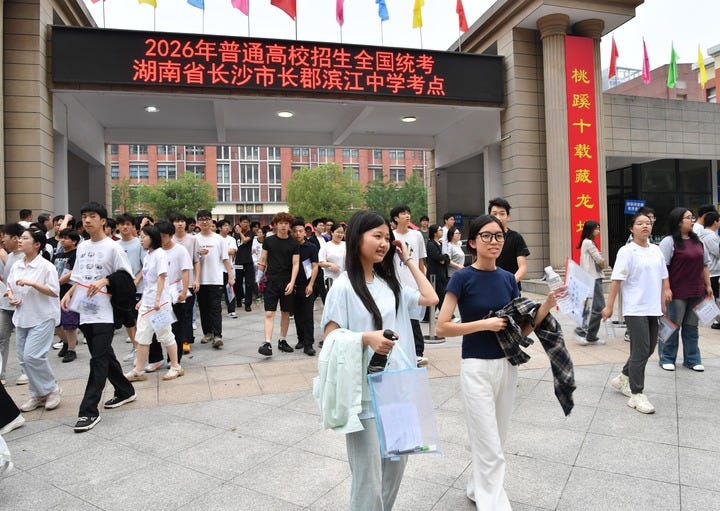
One of the major events in China over the past week was the gaokao, the country’s national college entrance examination, which has just concluded after four days. Readers familiar with China may know that the country has a long tradition of selecting talent through examinations, dating back to the imperial era. At the time, the written word and the classical canon formed the core of the examination, and candidates were already required to compose essays in response to prescribed topics.
Today’s gaokao covers a much broader range of subjects across the humanities and sciences, but essay writing remains an important part of the Chinese-language exam. Each year, the essay prompts also become a subject of lively public discussion. In today’s edition, I would like to introduce this year’s prompts, which I think offer an interesting window into the concerns, ideas and changing rhythms of Chinese society.
A brief note on how the papers are organized: the two essay prompts used in the national Chinese-language papers in 2026 — known as National Paper I and National Paper II — were both centrally prepared by the Ministry of Education’s National Education Examinations Authority (NEEA). Beijing, Shanghai and Tianjin, meanwhile, set their own exam papers.
全国I卷
阅读下面的材料,根据要求写作。(60分)
词语是表达思想情感的载体,也是展现社会生活变化的窗口。当前,世界之变、时代之变、历史之变正以前所未有的方式展开。青年是常为新的,在你的成长过程中,你对哪一个词语的理解发生了变化?这变化有你成长的印记,对你有特殊的意义……
以上材料引发了你怎样的联想和思考?请写一篇文章。
要求:选准角度,确定立意,明确文体,自拟标题;不要套作,不得抄袭;不得泄露个人信息;不少于800字。
National Paper I
Read the following material and write as required. (60 points)
Words are vehicles for expressing thoughts and emotions, and also windows through which changes in social life can be observed. At present, changes in the world, the times, and history are unfolding in unprecedented ways. Young people are always open to the new. During the course of your growth, which word has undergone a change in your understanding? This change bears the imprint of your growth and holds special meaning for you...
What associations and reflections does the above material inspire in you? Write an essay.
Requirements: Choose an appropriate perspective, establish a clear central idea, specify the genre, and create your own title; do not use a formulaic essay or plagiarize; do not disclose personal information; write no fewer than 800 Chinese characters.
If I were to answer this question, I would probably choose the word songchi (松弛), or “relaxedness.”
In the past, songchi (松弛) was understood largely in its literal sense: the opposite of tension or tightness, describing a body, atmosphere or state of mind that had relaxed. In recent years, however, the word — especially in the phrase songchigan (松弛感), or “a sense of relaxed ease” — has taken on a richer social meaning. It now often refers to the striking composure some people display amid pressure, competition and uncertainty: an ability to remain natural, self-possessed and at ease when the circumstances around them are anything but relaxed.
In an increasingly fast-paced and anxiety-ridden society, “relaxedness” has thus come to describe not simply a comfortable condition, but a valued capacity to stay grounded under pressure.
全国II卷
阅读下面的材料,根据要求写作。(60分)
“日月不失其体,故蔽而复明;江汉不失其源,故穷而复通。”
在个人成长、社会发展乃至文明演进中,总会出现困顿、挫折,甚至会有风高浪急、惊涛骇浪的考验。然而,日月虽有被遮蔽之时,只要本体未失,终能重放光明;江河即使遭遇险阻,只要源头不竭,终能贯通入海。
以上材料引发了你怎样的联想和思考?请写一篇文章。
要求:选准角度,确定立意,明确文体,自拟标题;不要套作,不得抄袭;不得泄露个人信息;不少于800字。
National Paper II
Read the following material and write as required. (60 points)
“The sun and moon do not lose their essential nature, and therefore shine again after being obscured; the Yangtze and Han rivers do not lose their sources, and therefore flow freely again after being blocked.”
In personal growth, social development, and even the evolution of civilizations, there will always be difficulties and setbacks, and sometimes even trials of high winds, choppy waters, and dangerous storms. Yet although the sun and moon may at times be obscured, as long as their essential nature remains, they will eventually shine again; and although rivers may encounter obstacles, as long as their sources do not run dry, they will eventually flow through to the sea.
What associations and reflections does the above material inspire in you? Write an essay.
Requirements: Choose an appropriate perspective, establish a clear central idea, specify the genre, and create your own title; do not use a formulaic essay or plagiarize; do not disclose personal information; write no fewer than 800 Chinese characters.
The opening line about the sun and moon comes from the chapter “Adversity and Success” in Comprehensive Meaning of Customs (Fengsu Tongyi 《风俗通义·穷通》), written by Ying Shao during the Eastern Han Dynasty (25–220 CE). Drawing an analogy from nature, the saying conveys the idea that difficulties can be overcome as long as one remains anchored in what is fundamental. Its philosophical depth and affirmative message have made it a familiar reference in personal encouragement, essay writing and broader reflections on the development of nations and civilizations.
Another sentence that caught my attention was the reference to “trials of high winds, choppy waters, and dangerous storms.” The wording clearly echoes a passage from the Communique of the Fourth Plenary Session of the 20th Central Committee of the Communist Party of China issued last year, which described the development environment facing China during the 15th Five-Year Plan period, from 2026 to 2030:
In this period, China’s development environment will face profound and intricate changes. At present, China remains in a phase of development where strategic opportunities exist alongside risks and challenges, while uncertainties and unforeseen factors are rising … We must proactively identify, respond to, and steer changes, demonstrate the courage and competence to carry forward our struggle, and dare to brave high winds, choppy waters, and even dangerous storms.
Chinese policymakers have long “把个人追求融入国家发展大局” encouraged young people to align their personal aspirations with the country’s broader development. It is therefore not particularly surprising that the Ministry of Education’s exam authorities would draw on such language when designing the prompt.
Read together, National Papers I and II present an interesting contrast. Paper I uses changes in the meaning of words to reflect personal growth and the changing times, while Paper II turns to what remains unchanged — one’s essential nature and source — to invite reflection on the foundations that sustain development. Together, the two prompts form a dialectic of change and continuity.
The Paper, a prominent Chinese news outlet, said the pairing appears intended to encourage students to preserve enduring principles while pursuing innovation, and to break new ground while remaining firmly rooted.
北京卷
微写作
从下面三个题目中任选一题,按要求作答。不超过150字。不透露所在区、学校及个人信息。
(1)为增强同学们的劳动意识,班级打算利用半天时间走进社区开展劳动实践活动,现征集同学们的建议。你想设计一项怎样的活动?请说说理由。要求:写出活动的主要内容,理由充分,条理清晰。
(2)重阳节到来之际,学校拟组织志愿者到敬老院开展“人工智能(AI)与幸福晚年”主题活动。请你写一段活动的宣传语,吸引老人们积极参加。要求:语言得体,有吸引力。
(3)请以“因为向往”为题目,写一首小诗或一段抒情文字。要求:感情真挚,语言生动,有感染力。
Beijing Paper
Short Writing
Choose one of the following three topics and respond as required. Write no more than 150 Chinese characters. Do not disclose your district, school, or personal information.
(1) To strengthen students’ awareness of labor, the class plans to spend half a day participating in a community-based labor activity and is now soliciting suggestions from students. What kind of activity would you design? Explain your reasons. Requirements: Describe the main content of the activity, provide sufficient reasons, and organize your response clearly.
(2) As the Double Ninth Festival approaches, the school plans to organize volunteers to visit a nursing home and conduct an activity themed “Artificial Intelligence (AI) and a Happy Later Life.” Write a promotional message for the activity to encourage older people to participate actively. Requirements: Use appropriate and appealing language.
(3) Write a short poem or a piece of lyrical prose entitled “Because of Longing.” Requirements: Express sincere emotions, use vivid language, and make the writing moving and engaging.
I found the short-writing section of the Beijing paper particularly interesting. When I was in secondary school, about 20 years ago, I do not recall this kind of question being part of the exam. The third option especially stood out: it explicitly allows students to respond with a poem. Back when I was at school, some students — myself included — enjoyed writing poetry in their spare time. But choosing to write a poem in a high-stakes college entrance examination would have required considerable courage. The fact that students are now openly encouraged to do so is, in my view, something worth welcoming.
The theme of the second option, “Artificial Intelligence (AI) and a Happy Later Life,” also speaks closely to China’s current social realities. On the one hand, AI is developing so rapidly that almost every field now seems to be finding some connection to it. On the other, the country’s population is visibly aging. By bringing these two trends together and asking young people to think about how AI might improve the lives of older adults, the prompt creates a combination that I found both timely and intriguing.
北京卷
作文
从下面两个题目中任选一题,按要求作答。不少于700字。将题目写在答题卡上。不透露所在区、学校及个人信息。
(1)学海无涯,读书有法。元代学者程端礼编撰的《读书分年日程》,分阶段详细规定了核心经典的阅读顺序与精读方法,陪伴读书人从童蒙成长为青年。无论是个人的阅读与成长,还是国家、社会的发展,都需要做好规划,循序渐进;也需要身体力行,下足功夫。
请以“做规划与下功夫”为题目,写一篇议论文。
要求:论点明确,论据充实,论证合理;语言流畅,书写清晰。
(2)“含英咀华”指含着花朵,细细咀嚼,品味花的芬芳,比喻仔细琢磨、领会诗文中的精华。这种反复品味、用心体悟的过程,在阅读经典、鉴赏艺术、感悟生活等诸多方面都非常重要。含英咀华的过程,往往是一段难忘的经历……
请以“含英咀华”为题目,写一篇记叙文。
要求:思想健康;内容充实、合理,有细节描写;语言流畅,书写清晰。
Beijing Paper
Essay
Choose one of the following two topics and respond as required. Write no fewer than 700 Chinese characters. Write the title on the answer sheet. Do not disclose your district, school, or personal information.
(1) The sea of learning has no bounds, but there are methods for reading. The Schedule for Reading by Years and Days, compiled by the Yuan Dynasty scholar Cheng Duanli, set out in detail, by stages, the order in which core classics should be read and the methods for intensive reading, accompanying learners from early childhood education into youth. Whether in an individual’s reading and growth or in the development of a country and society, it is necessary to make sound plans and proceed step by step; it is also necessary to put plans into practice and devote sustained effort.
Write an argumentative essay entitled “Making Plans and Putting in the Effort.”
Requirements: Present a clear argument, provide substantial evidence, and develop reasonable reasoning; use fluent language and write clearly.
(2) The expression “savoring the essence” literally refers to holding flowers in one’s mouth, chewing them slowly, and appreciating their fragrance. It is a metaphor for carefully examining and understanding the finest elements of poetry and prose. This process of repeated appreciation and attentive reflection is highly important in many areas, including reading classics, appreciating art, and experiencing life. The process of savoring the essence is often an unforgettable experience...
Write a narrative essay entitled “Savoring the Essence.”
Requirements: Express sound and positive ideas; provide substantial and reasonable content with detailed descriptions; use fluent language and write clearly.
One of the prompts in this section focuses on the importance of making plans, while the other emphasizes the value of studying something closely and engaging with it in depth. I do not have much more to add here.
天津卷
阅读下面的材料,根据要求写作。(60分)
画家把手中的颜料放入调(tiáo)色盘,精准调(tiáo)整比例,以缤纷的色彩绘就美好画卷;南水北调(diào)工程合理调(diào)动一切可以利用的资源,主动改变水道,使自然更好地造福人类。调,一字双音,既有顺势而为的选择,又有不拘一格的创造。
以上材料能引发你怎样的联想与思考?请结合你的体验和感悟,写一篇文章。
要求:①自选角度,自拟标题; ②文体不限(诗歌除外),文体特征明显;
③不少于800字; ④不得抄袭,不得套作。
Tianjin Paper
Read the following material and write as required. (60 points)
A painter places pigments on a palette “调(tiáo)色盘” and precisely adjusts “调(tiáo)整” their proportions to create a beautiful picture with brilliant colors; the South-to-North Water Diversion Project “南水北调(diào)” rationally mobilizes “调(diào)动” all available resources and actively alters waterways so that nature can better benefit humanity. The Chinese character “调” has two pronunciations and meanings: one (tiáo)refers to making choices in accordance with circumstances, while the other(diào) refers to unconstrained creativity.
What associations and reflections does the above material inspire in you? Drawing on your own experiences and insights, write an essay.
Requirements: ① Choose your own perspective and create your own title; ② Any genre is permitted except poetry, and the characteristics of the chosen genre should be clearly demonstrated;
③ Write no fewer than 800 Chinese characters; ④ Do not plagiarize or use a formulaic essay.
Chinese has many characters with multiple pronunciations, and a character can carry different meanings depending on how it is pronounced. Sometimes, those different meanings can even be placed in a kind of dialectical or philosophical relationship with one another — an approach long favored by Chinese writers and exam setters. If your language has anything similar, I would be interested to hear about it in the comments.
上海卷
写作 70分
每个人都有对世界的想象。科技改造世界时,也改造着我们的想象,对此你有怎样的认识和思考?请写一篇文章。要求:(1)自拟题目;(2)不少于800字。
Shanghai Paper
Writing 70 points
Everyone has their own imagination of the world. As technology transforms the world, it also transforms our imagination. What are your views and reflections on this? Write an essay. Requirements: (1) Create your own title; (2) Write no fewer than 800 Chinese characters.
Shanghai’s essay prompt is concise and its theme is clear: technology. “Embrace Shanghai’s historical role as a leading international center for scientific and technological innovation and to build itself into a globally renowned sci-tech high ground” has been an important goal set for the city by China’s central authorities in recent years. Last year, I also produced a podcast episode about Silicon Valley investors visiting Shanghai for the World Artificial Intelligence Conference (WAIC) and experiencing China’s AI boom firsthand. Those interested can give it a listen.
What Silicon Valley Learned in Shanghai: China’s AI boom - with Rui Ma

This week on Inside the China Room with Jiang Jiang, I’m joined by Rui Ma — founder of Tech Buzz China and longtime tech analyst— to unpack what’s really happening inside China’s fast-moving AI ecosystem.
Very interesting! I have studied exams in the West from around 1850-1990, and have two points:
First, these are probably around the level of Scottish and English exams c. 1920-1960, which were for 16-17 year-old leavers.
Second, without knowing the marking rubrics or expectations from markers, it is hard to get a sense how interesting these questions are to prepare for.
Putting the second point to one side, I have noted before the paradox that communist countries, despite being more closed and egalitarian, often set more open-ended and stratified examinations.