

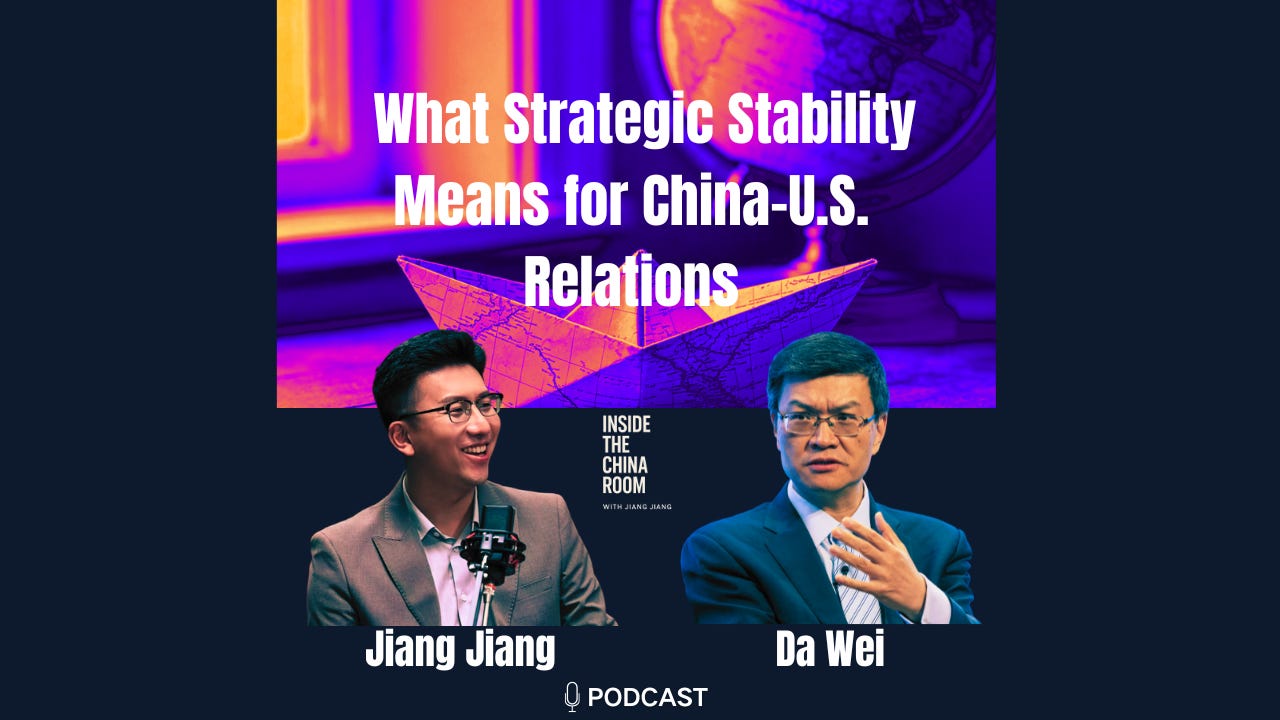
In this episode of Inside the China Room with Jiang Jiang, I’m joined by Da Wei, Director of the Center for International Security and Strategy (CISS) and a Professor in the Department of International Relations at Tsinghua University. His research focuses on China-U.S. relations, as well as U.S. security and foreign policy. Da Wei is regarded by many overseas China watchers as one of Beijing’s most prominent voices on U.S.-China relations.
On September 7, Foreign Affairs published an article by Da Wei, titled “The Emerging U.S.-China Détente,” with the subtitle “A Confident Beijing and a Pragmatic Washington Can Get Along.” The article has drawn considerable attention among observers of China-U.S. relations.
The timing is particularly interesting. Chinese President Xi Jinping is expected to visit Washington this month for another meeting with U.S. President Donald Trump this year. The two leaders could also meet again later in the year around the APEC and G20 summits.
Da Wei has been a frequent participant in Track Two and people-to-people exchanges between China and the United States, traveling regularly between the two countries for dialogue with academics, former officials, and business leaders.
In today’s episode, Da Wei discusses what “constructive strategic stability” means for China-U.S. relations and what to watch for in the next leaders’ meeting. We also talk about Taiwan, AI, the thinking behind his recent Foreign Affairs article, and what years of Track Two and people-to-people exchanges have taught him about how the two countries see each other.
With three decades of experience spanning China’s academic and policy communities, Da Wei has built a career in both think tanks and higher education. He spent more than two decades at the China Institutes of Contemporary International Relations, or CICIR, where his last position was Director of the Institute of American Studies from 2013 to 2017. He later served as Assistant President at the University of International Relations. Since January 2021, he has been at Tsinghua University.
Beyond his institutional roles, Da Wei is Vice President of the Chinese Association of American Studies and serves on the boards of multiple academic organizations.
Da Wei holds a BA and MA from the University of International Relations in Beijing and a PhD from CICIR. His international academic experience includes visiting appointments at the Atlantic Council, Johns Hopkins University, Stanford University, and Nanyang Technological University.
Highlights:
02:50 – What “constructive strategic stability” means for China-U.S. relations
08:55 – How Da Wei assesses the idea of strategic stability in recent China-U.S. interactions
13:51 – Leader-level meetings and their role in China-U.S. relations
18:07 – How Da Wei sees his Foreign Affairs article and his role as a scholar
22:37 – Taiwan and what to watch for in the next leaders’ meeting
28:21 – Track Two dialogue, face-to-face exchanges, and mutual understanding
39:33 – How younger Chinese and Americans see the bilateral relationship
44:45 – The prospects for China-U.S. dialogue on AI
52:31 – Book recommendations
Recommendations:
Da Wei: The Neighborhood: Space, State, and Daily Life in a Manchurian City (西塔) , by Song Niansheng
Jiang Jiang: Beijing and Washington Can Build AI Safety Despite Mutual Distrust, by Xiao Qian
Enjoyed the episode?
Follow Inside the China Room on Apple Podcasts, Spotify, or YouTube. New episodes drop every two weeks. Share & rate us to help more listeners discover expert perspectives from inside China.
This episode was recorded on Sept. 16.


