

About a year ago, the sudden emergence of DeepSeek reshaped global perceptions of China’s AI ecosystem. Twelve months on, China and the United States are now visibly locked in a fast-moving race across both AI models and the semiconductor stack. One striking marker of this momentum came at the turn of the year: between the final month of 2025 and the opening weeks of 2026, China saw an unusually dense wave of high-profile AI and AI-semiconductor IPOs across the A-share market and Hong Kong.
In his China Translated newsletter, Robert Wu compiled a telling list of these listings — from GPU and AI-chipmakers such as Moore Threads, MetaX and Biren, to foundation-model developers like Zhipu AI and MiniMax, alongside memory and accelerator players preparing to tap public markets later this year. The compressed timing and breadth of these offerings underscore how China’s AI industry is now moving into a new, capital-market-driven phase.
Among this cohort is Zhipu AI, which OpenAI has previously described as one of China’s “AI tigers” — startups building large language models intended to rival leading Western players. Zhipu listed on the Hong Kong Exchange on Jan. 8, raising HK$4.35 billion and achieving a valuation close to US$9 billion, making it China’s first AI software company to go public.
Compared with some of its peers, including MiniMax, which debuted a day later, Reuters cited Omdia chief analyst Lian Jye Su as saying that MiniMax’s focus on the consumer market appealed more to investors seeking high-growth opportunities, whereas Zhipu’s enterprise- and government-oriented model was perceived as more stable but less exciting in a market driven by hype.
According to STAR Market Daily, Zhipu grew out of Tsinghua University’s Knowledge Engineering Lab and has built a full-stack model portfolio spanning language, multimodal systems and AI agents. By mid-2025, its GLM model series had served more than 12,000 enterprise clients and 45 million developers worldwide, with nine of China’s top ten internet companies adopting its services. In 2024, Zhipu ranked second among China’s general-purpose foundation-model developers by market share — and first among independent developers.
The listing has also brought renewed attention to the personal story of Zhipu’s founder and CEO, Zhang Peng. An engineer trained at Tsinghua University, Zhang spent more than two decades in academia before turning laboratory research into a commercial AI company now valued at over HK$50 billion, according to STAR Market Daily.
Shortly before Zhipu’s IPO, one of my favorite Chinese-language programs, 張小珺Xiaojùn Podcast, released a nearly two-and-a-half-hour, long-form interview with Zhipu AI founder and CEO Zhang Peng. The conversation goes well beyond a standard IPO or founder profile. It ranges from why large-model companies are going public before AGI has been achieved, to how Zhang understands the relationship between capital markets, technological cycles, and long-term AGI research.
Zhang speaks at length about Zhipu’s strategic choices — including its enterprise-first orientation, its restrained approach to consumer products, and why it prioritizes stability and controllability over hype-driven growth. He also reflects on misconceptions surrounding Zhipu as a “to-G” company, discusses comparisons with peers such as MiniMax and Kimi, and offers unusually candid views on commercialization paths, investor expectations, and whether today’s AI boom should be understood as a bubble.
Beyond strategy and markets, the interview delves into Zhang’s personal trajectory: from Tsinghua University’s Knowledge Engineering Lab to founding Zhipu, navigating China’s evolving rules on academic commercialization, and building a company while remaining anchored in long-horizon AGI ambitions. The discussion also touches on talent competition, research-to-product translation, and how Chinese AI founders assess risk, patience, and timing differently from their U.S. counterparts.
Following the episode, the host published a carefully curated written version on the Language Is World WeChat blog. I’ve translated that text into English and am sharing it here.
I’m highlighting this podcast — and others like it — for a reason. I believe stories of how Chinese technology companies are built are still seriously underestimated outside China. Competition in China’s tech sector, both in markets and in talent, is extraordinarily intense, and firms that manage to break through are worth closer attention.
Long-form podcasts provide a rare opportunity to understand how these companies and founders actually think. I’ve previously collaborated with Zhang Xiaojun on introducing the development story of TikTok, and have also published English write-ups of several podcast episodes hosted by Luo Yonghao. If you’re interested, you can find links to those pieces at the end of this post.
01
On Going Public
“I guess I’d just wish everyone good luck.”
Zhang Xiaojun: I was thinking about it, and Zhipu might become not only China’s first large-model company to go public, but possibly the first in the world — moving faster than OpenAI. Why is it that AGI has not yet been achieved, yet companies like yours are already lining up to go public?
Zhang Peng: There are indeed many reasons behind this. I have never believed that achieving AGI would be easy, nor that it could be accomplished in a very short time. It is a marathon — a long-distance race. You have to persist.
At different stages, you have to get through the journey in different ways. For example, at the start of a marathon, if you want to break free from the congestion, you need to speed up a bit to get into the leading pack. In the middle stage, when many people can no longer hold on, you need to go to the supply station, replenish yourself, maintain your stamina, and constantly balance energy expenditure and intake. At different stages, the entire system needs to operate in different ways.
In our planning from the very first day the company was founded, we expected that in about six or seven years, we would be facing an IPO.
Zhang Xiaojun: When did you formally start preparing for the listing?
Zhang Peng: If you count backward based on the three-year performance period, it started around 2022 and 2023 — including how to commercialize, how to generate revenue, how to control costs, and how to grow the team. All of these were carried out simultaneously.
Zhang Xiaojun: In your view, not just for you but for this wave of AI companies going public, what kind of milestone does this represent for AGI?
Zhang Peng: From the perspective of capital markets, when you are still in the primary market, it’s like you haven’t really left school yet — you’re still learning, being nurtured, and growing. After entering the secondary market, you move into a stage that is much closer to the real market.
For the industry, it is also a milestone. It proves that this is not something illusory — not a flower in the mirror or the moon reflected in water. It is something that can truly reach an industrial scale.
Zhang Xiaojun: Is part of the reason that, at this point in time, investors also want an exit and want to lock in their gains?
Zhang Peng: I don’t rule out that some people think that way. But I think many of our investors share the same beliefs and ideas as we do — wanting to continue walking this path together and achieve even greater success.
It’s not that we go public and then immediately exit, cash out, and say, “OK, we’ve made money.”
Zhang Xiaojun: Recently, people often discuss you together with MiniMax, because both of you are competing for the title of “China’s first large-model stock.”
(On the day of the interview, it was still unclear who would become the first.)
Zhang Peng: Mainly because the timing is so close. I’ve seen online analyses, and many of them are quite fair. The two companies each have their own characteristics and their own development paths.
Of course, I won’t comment on MiniMax itself. But at least from our own perspective, the ideals, ideas, and underlying motivations that Zhipu carries are not something that can be clearly understood from a prospectus or a few dozen pages of materials.
Recently, I’ve also spent time talking with many friends, hoping to help people better understand the thinking behind Zhipu and the motivations behind what we are doing, so that unnecessary and one-sided misunderstandings don’t arise.
Zhang Xiaojun: Is there anything you’d like to say to MiniMax CEO Yan Junjie?
Zhang Peng: I’ve spoken with Teacher Yan a bit less recently; before, we talked quite often.
Zhang Xiaojun: Why less recently?
Zhang Peng: Fewer chances to run into each other.
Zhang Xiaojun: So is there anything you’d like to say to him?
Zhang Peng: I guess I’d just wish everyone good luck.
Zhang Xiaojun: How do you view the possibility that OpenAI might also go public?
Zhang Peng: I’ve heard that they are preparing as well. OpenAI is probably another story altogether. In the U.S. environment, it’s what you’d call “high risk, high investment, high return” — the “three highs.”
Zhang Xiaojun: And you?
Zhang Peng: We are relatively more aligned with China’s conditions. In high-risk or high-tech fields, we pursue stability, controllability, and predictability.
Zhang Xiaojun: How do you deal with post-IPO pressure — technical investment, computing-power investment, and pressure from the secondary market? After going public, could you instead become an ordinary, mediocre company?
Zhang Peng: I don’t think so. This is also why I mentioned earlier why we hope, through your program, to let more people understand what Zhipu is really thinking and doing. Many things originate from gaps in understanding between people and from mutual misunderstanding.
Zhang Xiaojun: What do you think is being misunderstood?
Zhang Peng: Some people may think: “Look, they’re just doing project outsourcing, a to-G company, revolving around government.” I don’t think that’s the case. There are many deeper factors involved.
On the surface, nine of China’s top ten internet companies are our clients, and they are all very important clients. About 60% of our clients are enterprises. The government side accounts for only about 20% — actually quite small.
If you say we are a to-B company, that I can accept. To-G is not what truly makes up the majority of our business.
We have always said that we serve enterprises, because enterprises are where productive interests are most concentrated in society and where conversion efficiency is highest. A technology at the level of a productivity revolution naturally needs to land in such places.
This is the most straightforward logic, and it’s something that people with engineering or science backgrounds like us easily arrive at.
02
On Entrepreneurship
“But you’re right.”
Zhang Xiaojun: I feel that you weren’t fully prepared when you became CEO, and then you were pushed into a huge wave. Over the past three years, what has that felt like?
Zhang Peng: How do you know I wasn’t prepared?
…
But you’re right.
Zhang Xiaojun: Why did Tsinghua have you start this company? Who asked you to become entrepreneurs?
Zhang Peng: No one asked us to do it. It was something we wanted to do ourselves.
When I was working in the lab, I was responsible for engineering transformation. Professors led students to do research, and after the research was done, they might publish papers — but I had to deliver it to enterprise clients.
Enterprise clients don’t just want a paper or a prototype. They need a system, a product. I led a group of people to do exactly that.
Zhang Xiaojun: Has Tsinghua always had positions focused on engineering transformation?
Zhang Peng: Our department always has, and our lab especially so. It’s our tradition.
Since my advisor founded the lab, he has placed great emphasis on this. He proposed a concept called P2P — Paper to Project, or Paper to Product. That is, your research results in papers must be transformed into products or systems that can actually be used.
In 2017, we began trying to figure out how to make this commercialization path work within the university system.
At that time, it was not allowed for people within the system to start companies.
Zhang Xiaojun: Were there no precedents before?
Zhang Peng: There were, but not through formal, official channels. A professor might quietly start a company outside, and as long as no one reported it, it would pass. But strictly speaking, this required reporting to and approval from the university.
Zhang Xiaojun: Did you ever think about just doing it quietly and dealing with it if discovered later?
Zhang Peng: That would always leave loose ends. This was an obsession for our group — to take the official route.
The turning point came in 2018, when the state — including the Ministry of Education and several other ministries — jointly issued an opinion allowing in-service researchers at scientific institutions to commercialize the results of their research.
It was like opening a window — people suddenly saw that there was another path outside. But it wasn’t like opening a wide door saying, “Go ahead, do whatever you want.” It still wasn’t easy. We took this policy and talked with the university: “What do we do? We want to do this — how do we proceed?”
The university actually also wanted to do this. That regulation came out in January 2018. Studying the details and completing the entire process, the company wasn’t registered until June 2019 — a year and a half.
We were the first to eat the crab.
Zhang Xiaojun: When you first went out to raise funds and talked to investors, were they excited?
Zhang Peng: Investors didn’t understand at all. They completely didn’t understand. “What is this thing? How do you make money? How do you commercialize it?” These were the questions they asked.
I remember one investor very clearly. We chatted online, and he said, “Can this thing actually become money? Look at how bad the macro environment is right now, how bad the economy is. Why don’t you cut your valuation in half?”
When ChatGPT became popular, it helped us enormously. No one questioned anymore what this thing actually was.
We just said to them: “You know ChatGPT, right? You’ve seen it, right? What we’re doing is moving in that direction.”
03
On Comparison
“He can do things beautifully, but there isn’t much emotional value.”
Zhang Xiaojun: I’ve heard a comment about Zhipu. Zhipu has never really been the most star-like project in the market, nor the one with the highest attention. You have technology and vision, but you seem a bit boring.
Someone described it to me as “like cement” — not very interesting, but very stable. Is that a fair assessment?
Zhang Peng: I think it’s fairly accurate — just like how people describe Tsinghua engineering guys: boring.
Very smart, very capable. If you give them a serious task, they can execute it beautifully. But there isn’t much emotional value.
Zhang Xiaojun: Compared with you, isn’t Kimi a bit cooler? Also a Tsinghua engineering background.
Zhang Peng: Yes. That’s something I really admire about Zhilin. He’s very good at capturing the attention of ordinary people, knowing how to promote things and how to understand users’ needs and thinking. We may not do as well in that regard, and it also relates to our positioning.
Zhang Xiaojun: When did you decide not to go deeply into to-C? That must have been an important decision.
Zhang Peng: It’s not that we decided not to do to-C. We actually do — we developed the Zhipu Qingyan app, and the cloud version of ChatGLM, and we are still working on them.
It’s just that we don’t bet everything on a single option. We look at three or four models simultaneously and see which one can really work.
Zhang Xiaojun: Did you ever buy traffic for Zhipu Qingyan?
Zhang Peng: Of course we did. There’s no need to deny that.
Zhang Xiaojun: How long did it take to realize you couldn’t win that battle?
Zhang Peng: It’s been a while. Later we realized that China’s consumer market has very weak willingness to pay. People really don’t like paying.
We did make some money from Qingyan.
Zhang Xiaojun: Did you ever think about competing directly with Doubao or Kimi?
Zhang Peng: That’s not our style.
Zhang Xiaojun: To-C will always be more attractive to investors than to-B.
Zhang Peng: I don’t really understand where that attraction comes from. Later I guessed one reason: the numbers are easier to calculate. How much is one user worth — that’s relatively straightforward.
But to-B is too complex. How much is a client worth? There are countless variables. It’s very hard to calculate clearly.
Zhang Xiaojun: When I look back now, the first thing that left a deep impression on me in 2023 was that Lao Wang issued a “hero’s call,” and then Wang Xiaochuan (founder and CEO of Baichuan Intelligence) entered the game.
When you saw these very successful entrepreneurs starting over and entering a market you had cultivated for years, what were you thinking? Did you worry about losing in business competition?
Zhang Peng: We had been doing this for a long time, and our understanding was relatively deep. Even though ChatGPT became popular, the road ahead is still long — it’s not that fast or easy.
Xiaochuan was actually nearby at the time — our offices were in the same building — so we often ran into each other downstairs.
He has a habit: when thinking, he would go downstairs to the open plaza in the tech park and sit cross-legged on a bench, thinking with an iPad in hand. Sometimes when I went down to buy coffee and ran into him, we’d chat for a bit.
Zhang Xiaojun: Then in 2024, the protagonists of the market seemed to change, becoming Yang Zhilin (founder and CEO of Moonshot AI) and Yan Junjie (chairman and CEO of MiniMax). How did you view Yang Zhilin at the time?
Zhang Peng: I had interacted with Zhilin several times. After all, he came from our lab. At school, he was the top-student type. When he later started Kimi, I thought he could succeed.
Zhang Xiaojun: How does it feel when fellow students start competing in the business world?
Zhang Peng: Tsinghua people have this trait — we’re all engineering types, quite rational.
When we’re together, we chat happily about being classmates. But business is business. When it comes to competition, you do what needs to be done. Everyone has their own rules and communication style.
Zhang Xiaojun: How do you view Yan Junjie of MiniMax?
Zhang Peng: He’s extremely smart. First, he chose the right direction; second, the right market. On that basis, he knows very clearly what he wants.
Zhang Xiaojun: What does he want?
Zhang Peng: I think he’s aiming directly at commercialization.
Look at what he’s doing — Talkie, voice, multimodal — all moving in that direction. Consumption, entertainment, spiritual value, emotional value. He’s very clear.
04
On the Bubble
“If it’s a bubble, can going public save AI?”
Zhang Xiaojun: I once talked with a founder from the AI 1.0 era, and he said that large-model companies going public now are essentially “escaping.”
Some market views suggest that the AI bubble might burst in 2026, and expectations for 2026 aren’t very optimistic. So at the end of 2025 and the beginning of 2026, if you can go public, you should do it quickly — it might be a favorable window.
Zhang Peng: First, assuming it is a bubble — can going public save us? Or can it save AI?
Zhang Xiaojun: It can save investors’ wallets.
Zhang Peng: That doesn’t save me, does it?
Whether it’s a bubble has no necessary relationship with whether you go public. You’re mixing two things together — I don’t agree with that. Logically, there’s no inevitable connection.
Second, there’s been a lot of discussion recently about whether it’s a bubble. I’m used to asking a counter-question: how do you define a bubble? What is a bubble?
Zhang Xiaojun: Every cycle has bubbles. What people worry about is a major crash like in previous cycles.
Zhang Peng: Why did those crashes happen? Overheated investment —投入得不到相应的回报.
So what’s the bubble now?
Zhang Xiaojun: The internet.
Zhang Peng: Everyone will tell you that the most recent bubble was the internet bubble. But look — even after it burst, what did it leave behind?
Many of the things people use and enjoy today were left behind by that bubble era. Why should you fear bubbles?
Zhang Xiaojun: Because you’re afraid of being the one that gets popped.
Zhang Peng: At the end of the day, it’s still about worrying about the money in your pocket.
It’s about whether you can recover your investment returns in time — not whether what you invested in actually produced real things, real productivity, or lasting value.
Once you look at it from that angle, the problem becomes easier to resolve. From an investment perspective, is investment in the U.S. enough? Is it enough in China? If investment isn’t enough, how can it be called a bubble?
Zhang Xiaojun: People think it’s not enough because AGI is still very far away.
Zhang Peng: Then if it’s far from AGI, should we stop pursuing AGI?
Zhang Xiaojun: Is AGI even achievable under the current technical paradigm?
Zhang Peng: If we don’t invest, will it just naturally happen?
Zhang Xiaojun: It won’t.
Zhang Peng: Then that’s the answer.
This is the general historical trend. The questions I’m asking are logically connected step by step. If you answer them, you’ll see that worrying about this is meaningless.
There will inevitably be bubbles during certain periods. The only question is the size of the bubble. You ask whether investment is enough — many people think it’s not.
I don’t dare say whether the U.S. has enough, but China definitely doesn’t.
Zhang Xiaojun: China has much less than the U.S.
Zhang Peng: Far less — only a fraction, maybe one-tenth or even one-twentieth. And much of that investment goes into infrastructure, scattered broadly rather than concentrated on a few leading players like in the U.S. So the situation is very different.
If you say there’s a bubble, maybe from a capital-market perspective in the U.S., there is one. But in China, it doesn’t exist.
It’s far from enough.
Zhang Xiaojun: I understand that you’re looking at this from a long historical perspective. But from a company perspective — Zhu Xiaohu (managing partner of Jinsha River Venture Capital) has said that the “six little AI dragons” of large models may end up not even as good as the previous generation’s “four little AI dragons.”
You started your companies to pursue a second-generation AI paradigm. So from the perspective of a listed company, what is the fundamental difference between second-generation AI companies and first-generation ones?
Zhang Peng: I’m not trying to refute his view, but I think his conclusion comes too early. The previous generation of AI companies are still alive — some of them are.
We’re still very early. If you count from 2023, it’s only been three years. If you count from our founding in 2019, it’s only been six-plus years.
Isn’t it too early to draw final conclusions?
He made a prediction. We’ll just let time prove it.
05
On Hope
“A pathfinder.”
Zhang Xiaojun: Since going public, are there any interesting behind-the-scenes stories?
Zhang Peng: Let me think. I went to attend Moore Threads’ bell-ringing ceremony. We’ve cooperated with Moore for quite some time, and they invited me. I told them I was going to learn and see how the bell-ringing works.
It really hasn’t been easy for anyone — this wave has been extremely, extremely difficult. Everyone has their own challenges. To make it this far, everyone can be called a hero.
Zhang Xiaojun: The act of ringing the bell seems kind of magical. Will you ring it hard or softly? With how much force?
Zhang Peng: I’ll first see how big the bell is — just kidding, just kidding.
Zhang Xiaojun: What kind of person is Zhipu’s chief scientist, Professor Tang Jie?
Zhang Peng: Professor Tang is exceptionally smart, but also highly execution-oriented and very passionate. Once he has figured something out, he pushes extremely hard, with great passion and focus.
Zhang Xiaojun: What is he pushing hardest right now?
Zhang Peng: Pushing the team relentlessly to keep improving the model’s capabilities. Of course, he’s also very concerned about the IPO.
You see why we always start our story from 2016 — it’s to convey one message: Zhipu isn’t simply about starting a company to make money. Our original intention is to explore what AGI actually is.
We just believe that doing this through a company, within industry, better fits the current stage of AI development — rather than just doing research, or simply making money.
Zhang Xiaojun: If you had to choose between building a company that achieves AGI and a company that makes huge profits, which would you choose?
Zhang Peng: Of course, the one that achieves AGI. No hesitation.
Zhang Xiaojun: Even if Zhipu achieves AGI and then fails — would that be acceptable?
Zhang Peng: That’s too inauspicious to say…
Of course we don’t want to fail. And I believe that if we can achieve AGI, we won’t fail. We would also be a great company. The two are not contradictory.
Zhang Xiaojun: Looking five years ahead, what outcome would leave you dissatisfied?
Zhang Peng: If we only make money but have no technological output or contribution to the industry, I would definitely be dissatisfied.
Zhang Xiaojun: A hundred years from now, if Zhipu appears in the history books of artificial intelligence, how would you like it to be written?
Zhang Peng: From my personal perspective, I hope there would be a line in the footnotes saying: Zhipu was a pioneer in the history of AGI.
We started doing this very early, including many technical breakthroughs. In many cases, we were the first to eat the crab.
Zhang Xiaojun: Being early matters to you.
Why not “innovator,” but “pioneer”?
Zhang Peng: A pioneer is often an innovator. A trailblazer — someone who clears the path. (Enditem)
Inside TikTok, Zhang Yiming's great voyage through the waves, Part 1

TikTok, one of the most internationally successful companies from China, marked "the first time that a content platform from China went deep into the heart of Western culture, and had set up a new paradigm for Chinese enterprise going overseas," according to
Inside TikTok, Zhang Yiming's great voyage through the waves, Part 2

This is Part 2 of the great article by Ms. 张珺 Zhang Jun on the insider stories from TikTok's spectacular rise. For Part 1, please check this translation from Ginger River.
China’s EV Pioneers: What a four-hour conversation with Li Xiang reveals about China’s EV revolution

In mid-August, Luo Yonghao — one of China’s best-known entrepreneurs-turned-internet personalities — launched his new podcast, 罗永浩的十字路口 Luo Yonghao’s Crossroads, across multiple platforms. His first two guests were Li Xiang, founder and CEO of Li Auto, and He Xiaopeng, chairman and CEO of XPeng. Li spoke with Luo for nearly four hours, while He joined f…
China’s EV Pioneers: What China’s EV revolution looks like through the lens of XPeng’s founder (part 1)
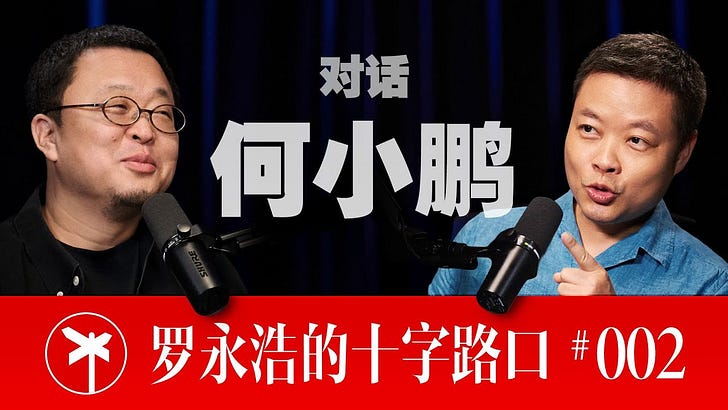
Today, I’d like to continue introducing the founders of China’s leading electric vehicle companies who sat down with Luo Yonghao — one of the country’s best-known entrepreneurs-turned-internet personalities. This edition features He Xiaopeng, co-founder, executive director, chairman, and CEO of premium EV maker XPeng.
China’s EV Pioneers: What China’s EV revolution looks like through the lens of XPeng’s founder (part 2)
Today’s edition features the second half of the 10 highlights I selected from a three-hour podcast conversation between XPeng CEO He Xiaopeng and Luo Yonghao — one of China’s best-known entrepreneurs-turned-internet personalities.