

I found myself unexpectedly moved while editing this episode. I had already heard Adrian tell these stories during our interview, but listening to them again made me appreciate how much effort Adrian and the people around him have put into building a professional wrestling scene in China, a country that few people would immediately associate with this kind of sports entertainment.
I’m not a wrestling fan, at least not yet. I’ve only just begun to learn about it. But I was touched by their persistence and how they’ve kept working toward their dream, sometimes making only a little progress, one show at a time, year after year.
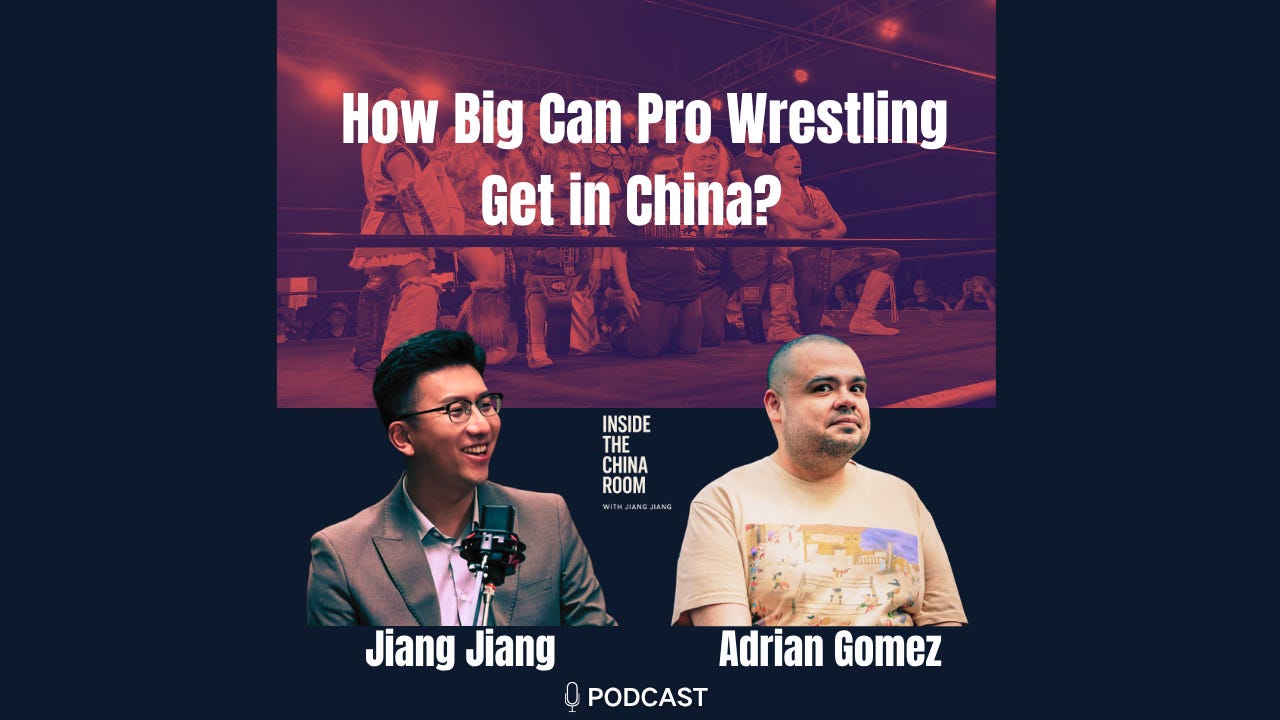
In this episode of Inside the China Room with Jiang Jiang, I’m joined by Adrian Gomez, an American who founded Middle Kingdom Wrestling (MKW) in 2015. MKW is an independent professional wrestling promotion that organizes live events in China, featuring both Chinese and international wrestlers.
On October 11, an event called MKW Speedway Slam took place in Tianjin, a city in northern China. The event featured five matches, bringing together wrestlers from China and other countries, including Hungary and South Korea.
I happened to be visiting Tianjin that day, and I watched all five matches. It was my first time watching professional wrestling live, and I certainly didn’t expect that my first experience would be here in China.
You might be wondering: Is professional wrestling really a thing in China? Who watches it? How do you introduce this kind of entertainment to Chinese audiences? And how has it adapted to local culture?
Adrian moved to China in 2010 after watching an Anthony Bourdain travel show featuring the northeastern city of Harbin. He initially worked as an English teacher, but his passion for professional wrestling eventually led him to establish MKW five years later.
In our conversation, Adrian looks back at MKW’s early days, when even free wrestling shows struggled to attract spectators, and explains how longtime wrestling fans help newcomers learn when to cheer and boo. He shares stories about the audience, including an elderly man in a wheelchair who attended MKW’s 10th-anniversary show in Beijing.
We also talk about how MKW incorporates local culture into its events, from traditional Chinese elements to a ring announcer using the Tianjin dialect, as well as how the organization brings international wrestlers to China and helps Chinese wrestlers gain experience overseas.
Adrian also discusses the business behind the spectacle: why running live wrestling events remains financially challenging and the unexpected popularity of a very different kind of wrestling on Chinese livestreaming platforms.
For those unfamiliar with professional wrestling, Adrian explains how wrestlers develop their characters, why losing a match can be just as important as winning, and what goes into putting together a live wrestling show.
After more than a decade of running MKW, Adrian remains committed to a goal that has proved difficult to achieve: helping more people in China make a living from professional wrestling.
Highlights:
04:06 – From a wrestling video game to Harbin, China
14:09 – MKW’s first wrestling show in China
22:58 – How Chinese audiences learn to cheer and boo
37:34 – Wrestling characters and local Chinese elements
45:19 – The business of professional wrestling in China
51:02 – The unexpected market for wrestling livestreams on Kuaishou
1:00:08 – What counts as Chinese culture in wrestling?
1:04:13 – Sponsorships, partnerships, and how to contact MKW
1:11:10 – International exchanges and opportunities for Chinese wrestlers
1:15:13 – The challenges facing women’s professional wrestling in China
1:18:09 – Organizing wrestling events and navigating local regulations
1:21:51 – Could AI-generated fight videos compete with professional wrestling?
1:25:09 – What would it take for China to produce a wrestling superstar?
1:27:26 – Looking back at life in China and ahead to MKW’s future
1:34:53 – Recommendations
1:38:17 – Adrian’s question for JJ and MKW’s plans for Shanghai in 2027
Recommendations:
Adrian Gomez: Obsession (movie), directed by Curry Barker
You Can See Everything (documentary), directed by Nathan Fielder, Lance Oppenheim. Adrian said he was looking forward to watching it.
Jiang Jiang: Great Wall of Pain: China’s Pro Wrestling Scene Found Its Rizz (2025), a video report by The World of Chinese featuring MKW’s 10th-anniversary event in Beijing. The elderly fan Adrian mentioned during our conversation also appears in the video.
Get in touch with MKW
For more information about MKW or potential sponsorships and business partnerships, you can contact the organization at mkwwrestling@qq.com or middlekingdomwrestling@gmail.com.
Adrian is also planning an MKW event in Shanghai, potentially in March 2027.
Enjoyed the episode?
Follow Inside the China Room on Apple Podcasts, Spotify, or YouTube. New episodes drop every two weeks. Share & rate us to help more listeners discover expert perspectives from inside China.


