

Headlines about China’s AI talent market tend to focus on eye-catching numbers: fresh PhD graduates being offered million-yuan salaries, tech giants fighting over top researchers, and a small group of star hires commanding pay packages more often associated with professional athletes.
Those numbers are real. But I think the more interesting question is what they tell us about the market itself: which skills are in short supply, what kinds of people companies are willing to pay more for, and how AI is changing hiring beyond the tech sector.
For today’s post, I selected parts of a recent episode of Zhibenlun (知本论), a Chinese podcast on business and finance that I listen to regularly. This particular episode looked at China’s AI talent market.
The name Zhibenlun is a play on the Chinese title of Das Kapital, Zibenlun (资本论), replacing the character for “capital” with one meaning “knowledge.” The show has nearly 100,000 subscribers on Xiaoyuzhou, one of China’s main podcast platforms. It is produced by CITIC Academy, the knowledge and learning platform of CITIC Press Group, one of China’s leading publishers.
The main guest was Max Xiao, founder of TTC (True Talents For China), an AI-focused recruitment firm. According to Xiao, TTC has served more than 1,500 AI companies across fields including computing chips, AI infrastructure, foundation models, embodied AI, robotics and agents.
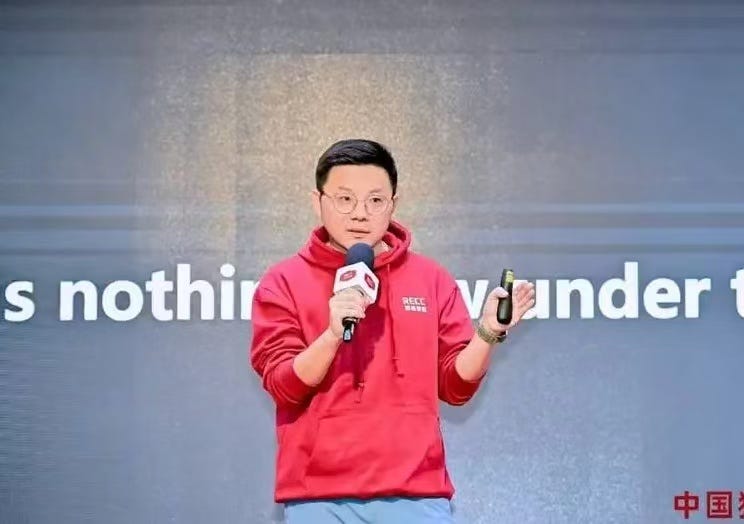
Max Xiao speaks at the 14th China Recruitment Firm Operators Annual Conference.
Also joining the conversation was Zhang Congzhi, a senior writer at Sanlian Lifeweek, a well-regarded Chinese current affairs and culture magazine, and one I have long enjoyed reading. Zhang has spent much of the past few years reporting on AI and the technology industry.
What follows is not a systematic survey of China’s AI labor market. But the conversation gives a more textured sense of what companies are paying for, where shortages are emerging, and how the definition of valuable talent is starting to change.
The excerpts below have been selected and lightly edited for length and clarity.
RMB 3 million for a new PhD is real, but it is far from normal
Host: When you see stories about AI recruitment these days, the headlines can be pretty startling. Someone graduates and immediately gets an annual package of more than RMB 1 million (about 150,000 U.S. dollars). Big companies are recruiting top students from Tsinghua, Peking University, Fudan or Shanghai Jiao Tong. It creates the impression that new graduates can make huge amounts of money in AI.
Max: I actually have a different view. A lot of AI companies are not making money right now. They are valuable because people believe this industry represents the future.
If we are talking about jobs, then yes, new graduates making more than RMB 1 million a year is real. There are even PhDs getting offers worth RMB 3 million, or roughly $445,000. But there is a reason that becomes news: it is not the norm.
A RMB 3 million package for a new PhD is not a one-off case. You do see this among graduates from Tsinghua, Peking University, Fudan, Shanghai Jiao Tong and other top schools. But the RMB 3 million is generally not cash. It is total compensation, including salary, bonuses, options or shares, plus other benefits.
For the great majority of people, it is nothing like that. Annual cash compensation may still be around RMB 300,000 to RMB 500,000, roughly $45,000 to $74,000.
You also have to look at what kind of company it is.
At the model layer, the large-model companies really do need extremely strong people. They will pay a lot, and they have raised a lot of money, which also gives them an advantage in attracting talent.
Then there is the infrastructure layer. And then there is the application layer.
For most ordinary people, I think there will be more opportunities at the application layer, because the technical threshold for the first two is still very high.
Host: So compensation varies a lot across different parts of AI, and even within the same company, depending on the department and role?
Max: Take a large-model company. We now hear about companies offering tens of millions of yuan, or even more, to recruit certain people.
If someone is an exceptional talent, or has actually worked on a major model and has that experience, the amount of value they can create and the resources they can manage can be enormous. Naturally, their market value goes up with that.
But if you are doing administrative work at a large-model company, you are not suddenly going to be paid far more than someone doing the same job elsewhere just because your employer works on AI.
Two things determine this. One is value. The other is supply.
It is very difficult to produce large numbers of people with experience training large models in a short period of time. But if you are looking for an HR person, an accountant or an administrative employee, there is much more supply in the market.
So in the end, it comes down to value and supply.
China’s AI job market is running hot and cold at the same time
Host: Looking at the market as a whole, what is the balance between demand and supply?
Max: It is extremely uneven. Some parts are parched, others are flooded.
For the very best people, if they decide they are open to opportunities, they may immediately have several offers in hand.
When Lin Junyang left Alibaba recently, a lot of investment firms contacted us because we happened to know him. They asked whether we could put them in touch. We connected him with several very well-known investors.
[Editor’s note: Lin Junyang is a former tech lead of Alibaba Cloud’s Qwen (Tongyi Qianwen) team and an AI research scientist who has played a prominent role in the development of China’s open-source AI ecosystem.]
That is what the very top end of the market looks like. Everyone wants the same person.
At the other end, you see huge numbers of people carrying résumés to recruitment events and still struggling to get a good result.
So the two sides of the market look completely different.
Host: Which positions are particularly short of people?
Max: You have to break it down by layer.
Take embodied AI, which is one area we recruit for. Earlier on, the sector did not have enough data. Now there is much more data, and companies need people who can train that data and build up the models. People with that capability are extremely scarce.
Where can you find them?
Some of them are already at large-model companies.
But those companies do not have enough talent themselves. Now embodied-AI companies are trying to recruit from the same pool, so the shortage becomes even worse.
And the market changes very quickly.
Not long ago, people who studied computer science and knew how to code were considered scarce. Now that large models have arrived, programmers are also among the first groups feeling pressure from the technology.
At the AI application layer, pure coding ability is no longer as scarce as it used to be. What matters more now is architecture: can you think about the whole product like an architect?
If more of the actual coding can be handed over to agents, then people are left to make judgments and aesthetic decisions. People with good judgment and taste become more important.
In the past, when we recruited someone, we looked at their résumé, experience and education. Which company had they worked for? How many years had they spent in a particular role?
Now more of the abilities companies care about are softer: architecture, taste, judgment, intuition.
That also makes hiring harder for companies. You need to be able to judge someone else’s judgment. You need to recognize whether they actually have good taste and whether they can think architecturally.
Demand for AI talent is moving beyond AI companies
Host: So AI talent is becoming scarce across industries, not just at companies we would normally label as AI companies?
Max: Exactly.
Last year it was mainly the biggest companies, companies with very large market capitalizations, and some more forward-looking entrepreneurs who had already begun investing in this.
This year it has spread across industries. Everyone is starting to ask: how do we use AI, and what kind of AI people do we need?
A couple of days ago I met a client, the CEO of Supermonkey, a Chinese pay-as-you-go gym chain.
He told me: “I’m using Codex to manage a lot of our company’s operations and my own daily work. If someone I hire is worse at AI than I am, then I don’t need to hire them.”
Think about that. This is a fitness company, and its CEO is already defining talent this way.
That gives you a sense of how much the standard is changing.
Host: But can companies actually describe accurately what kind of person they need?
There is a lot of AI anxiety across society right now. Almost every company thinks it needs an AI transformation and therefore needs AI talent. But many of them cannot clearly describe who exactly they are looking for.
Max: I think the great majority of companies have not really figured it out.
If a company brings no new AI talent into the organization, I basically would not expect it to change in any fundamental way.
The people you spend your time with shape the way you think. If you are still surrounded by the same people discussing the same things they always discussed, your thinking will not change, and neither will the organization.
If a traditional company really wants to turn itself into an AI organization, the cost will be substantial.
I even think a company may need a fairly large share of its people to change and bring more AI-native employees into the organization before that transformation can really happen.
For top talent, cash is only part of the equation
Host: When the very best people choose between companies, beyond the financial return, how much do they care about whether the work feels valuable or gives them a sense of accomplishment?
Max: Everyone needs some sense of meaning.
Money is certainly not the only motivation. It is a necessary condition, but it is not sufficient.
Once you reach a certain level, does another RMB 200,000, RMB 500,000 or RMB 800,000 really make that much difference?
Their cash salaries are actually not as extraordinary as people imagine. For many of these people, we may be talking about RMB 100,000 to RMB 200,000 a month, roughly $15,000 to $30,000.
I mentioned total compensation earlier. The biggest variable is often equity. That can become the largest part of what they ultimately earn.
So if one company offers you RMB 150,000 a month, another offers RMB 170,000, and a third offers RMB 200,000, the difference after tax may not be as important as people imagine.
For these people, the first question is often: can this thing actually succeed?
Because if it succeeds, that is when the biggest part of the upside, both in influence and financial return, becomes possible.
The second question is: if I go there, will I actually be able to use my abilities?
A CEO once came to me and asked whether we could recruit someone from Anthropic or OpenAI. He said, “I have money.”
But is this really about money?
You can offer someone a very high salary. But if they come back and discover that they cannot build the model they want to build because your resources are nowhere near the same level, why would they join you?
Whether the company can give them the resources to do the work matters enormously.
Another factor is talent density.
Someone can join a company, spend a few days there and realize that the people around them are simply not good enough. Then they leave.
If the talent density of an organization is too low, the best people will not come. And even if they do, they may not stay.
The level of the person they report to is also very important.
If they discover that their boss does not really understand the field, that they are learning nothing from them and are always the one doing the teaching, it becomes difficult to keep them.
AI is changing so quickly that even the people at the very top want to keep learning. Nobody really knows where all of this will end up.
They want to be surrounded by the strongest people, because that gives them a better chance of actually making something work.
How this talent race differs from the internet era
Host: Looking at the AI industry as a whole, do you think people will move between companies even more quickly?
Max: I think mobility will increase, and I am very much in favor of that.
Let the companies that work keep going. Let the ones that do not work die quickly. Then let the people move.
That is what happens in Silicon Valley. If a project does not work, people split up, then go off and form another company.
Zhang Congzhi: People move around quite frequently in China too, don’t they?
Max: There are a lot of non-compete clauses in China. But it also depends on bargaining power.
If you are a truly top-level person and a company desperately wants you, then it pulls out a non-compete restriction and you say, “Fine, then I won’t consider your company.”
At that point, who needs whom more?
If talent cannot move, knowledge cannot spread very easily either. The fact that we now have an open-source ecosystem helps.
Host: How is today’s competition for AI talent different from the scramble for talent during the internet era?
Max: I think there are several fundamental differences.
The first is supply.
During the internet era, companies needed a lot of engineers. It was largely about engineering capability. The talent supply was relatively sufficient. The challenge was identifying which people were better.
In the AI era, a very small number of exceptionally strong people can affect the competitive landscape. I think that is a fundamental difference.
The second is that the internet and mobile-internet eras were, to a large extent, competitions between business models.
In AI, the technical barriers are higher, and so are the barriers created by the knowledge and judgment of the very best people.
The third point is that, for ordinary people, I think the real opportunities are at the application layer.
In the internet era, many sectors eventually became dominated by a small number of giants.
AI is still at a very early stage. At the application layer in particular, I think there is still room for a lot of different companies and ideas to emerge.
So I am relatively optimistic.
Host: I’ve noticed that almost everyone I meet who actually works in AI tends to be optimistic.
Max: That’s because we spend all day around optimists. Eventually you become optimistic too.
China’s one-person company boom

OPC, short for One-Person Company, has become one of China’s hottest startup concepts. The defining idea is simple: a single founder wielding AI as a force multiplier. It began gaining traction in the second half of last year and has become even more popular this year.