

If you’re like me, you’ve probably read a great deal about China’s advances in robotics and embodied AI over the past couple of years. But what does it actually take to teach a robot to perform everyday tasks?
I recently came across a fascinating story published by Guyu Lab of Tencent News. The author took a temporary job collecting training data for robots, spending hours repeating simple movements such as squeezing toothpaste and lifting bottles.
The article is full of interesting details about the people doing this work. One thing that struck me was how humans must first learn to move almost like machines so that machines can learn to move like humans. It also shows how difficult it can be to collect reliable data, and how even the companies developing these systems don’t always agree on what the right movements should look like.
The story also points to a broader contradiction. China’s growing embodied AI industry is creating new jobs, including opportunities for young people. Yet these workers are helping train machines that may eventually replace people in many jobs. The article makes clear how far robots still have to go before they can match humans in even some simple tasks, but it also raises questions about what happens to workers as the technology improves. I think this is a very real challenge that countries around the world will have to confront.
The piece was originally published on October 8 on the WeChat account of Guyu Lab, a nonfiction storytelling platform under Tencent News known for its in-depth reporting on life in China.
Squeezing Toothpaste 240 Times a Day
My otherwise unremarkable left hand had acquired a distinctly high-tech look. Electrode pads were wrapped around all five fingers, and a square metal box sat on the back of my hand, linked to them by ten red data cables. A band strapped around my forearm was covered in an array of electrodes. This was a kit for collecting data for embodied AI, the kind of artificial intelligence that allows robots to act in the physical world. Whenever I exerted force with my fingers, it recorded the electrical activity in my muscles and the pressure I applied, turning each movement into a stream of digital signals.
My job was to copy the movements in the videos on the computer. There were 15 sets in all, including passing a book from one hand to the other; putting a pen into a cup and taking it out; picking up an apple with all five fingers and setting it back on the table; wiping the table with a cloth; turning an empty drinks can upside down; gripping a brush with all five fingers and rotating it to scrub a plastic cup; and picking up bowls and plates and moving them from one place to another.
Then there was squeezing toothpaste. First, pick up the tube with your thumb, index finger and middle finger. Move it sideways. Tilt it at 45 degrees. Apply moderate pressure with all three fingers. Return the tube to a horizontal position, then move it back to where it started.
Nobody squeezes toothpaste like this. People do it however they like. Some use a pea-sized amount; others prefer a long strip. We just hold the tube, without thinking about how many fingers we are using. The way we squeeze it today might be completely different from the way we did it yesterday.
But robots operate by a different logic. Movements have to be broken down and made precise. There is no room for ambiguity: before robots can learn to imitate us, we have to learn to imitate machines. I had signed up for a casual job collecting data for embodied AI through crowdsourcing. With every movement I made, my muscle activity and the pressure I applied were converted into data to train robots. The belief was that, with enough data, robots would learn to perform these movements as people do, helping us clean, cook, fold clothes and even squeeze toothpaste.
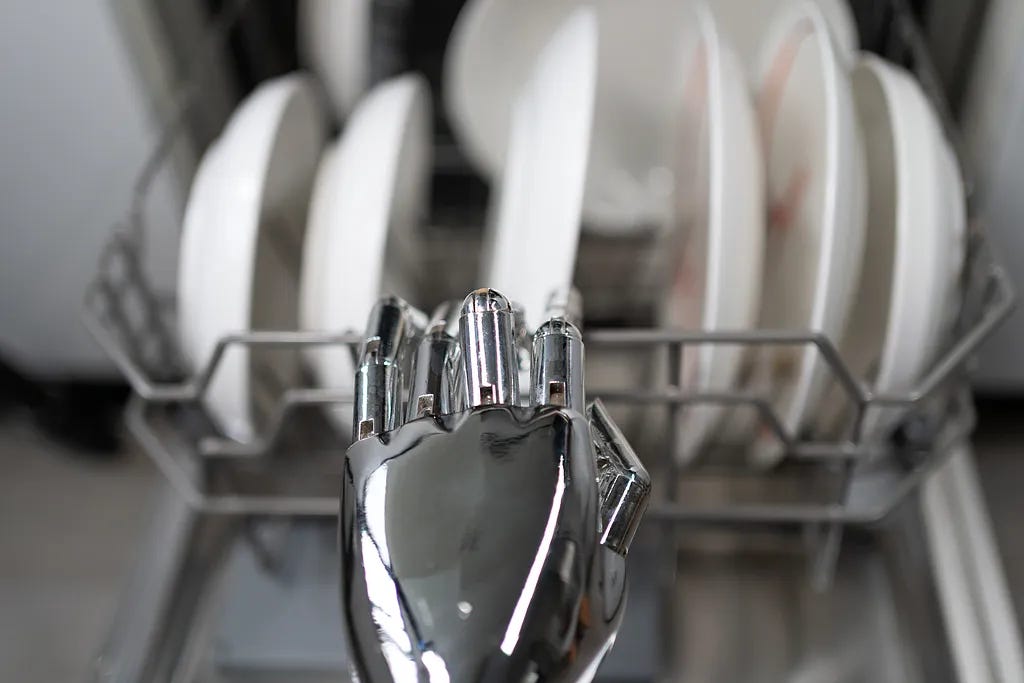
Photo credit: Visual China Group
Before any of that could happen, though, this was what I had to do that day: squeeze a toothpaste tube 240 times, lift a mineral-water bottle 1,200 times, put a pen into a cup 600 times and turn a drinks can upside down 400 times… After every five repetitions, I also had to take off the muscle-sensing band and put it back on, because sweat interfered with the signal. After all, I was on something like piece rates. Repeating one movement for a full two minutes, with a signal-quality score of at least 90, counted as one valid data record. I had to collect 155 records in a day to earn 180 yuan (about 27 U.S. dollars).
Many of the props had been handled so often they had acquired a patina. Take the drinks can. The video said to pick it up gently and turn it over, without using too much force. Yet even this metal object had been crumpled to the point of splitting. If my fingers had not been wrapped in a thin film, I might have cut myself. There were two apples on the table. One had begun to rot. The other felt very light when I picked it up. It was fake.
The toothpaste tube was not in much better shape. The first time I picked it up, I was completely unprepared for how it felt. It had been squeezed so many times that the middle was soft and crumpled, and the printed design was blurred from wear.
More than twenty of us were packed into the work area. At first, everyone stuck rigidly to the role of a machine, performing each movement exactly as prescribed. Every so often came the rip of Velcro as someone refitted their band as instructed. Some were quite enthusiastic. An older woman sitting behind me kept up a running commentary as she worked. “Oh, this is actually quite interesting!”
But people are not machines. Three or four hours later, most of us had slumped listlessly into our chairs, unable to lift another bottle or hold up another bowl. Props lay scattered across the tables. We kept picking up empty water bottles when we needed full ones, or full ones when we needed empty ones. Even a cleaning cloth lying right in front of us could seem impossible to find.
My shoulders began to ache. Boredom gave way to an inability to concentrate. My movements grew sloppy, and the electrode pad on my thumb slipped out of place. Eventually, it was no longer making contact with the props, whether the toothpaste tube or a paper cup. By then I had stopped caring. If I had to do it again, so be it.
To my surprise, the signal quality still registered as good. I had found a way to slack off.
Take It Seriously and You Lose
A large screen stood in the room, displaying a live dashboard: rankings by the number of records collected, rankings by the proportion of valid data, reasons records had been rejected, and so on. A supervisor of about thirty paced between the screen and our workstations, his hands clasped behind his back. Anyone producing invalid data or working too slowly was called out by name.
“You don’t leave until you’ve done 155! At least ten every half-hour!” Like an alarm clock, the supervisor kept reminding us. “Every day, someone ends up keeping me company until after seven. You’ve been warned.” When progress was slow, he went round asking each of us whether we wanted overtime, at 1.40 yuan a record. He spotted a young woman chatting on WeChat. Instead of telling her off, he asked, “Whoever you’re talking to, aren’t they coming to work here too?”
On the big screen, my total stayed firmly in the top ten, which pleased me immensely. I had no idea why my movements could fall short of the standard and still pass the signal-quality check, but it was certainly good news for me. Then I looked further up the rankings and noticed that the young man beside me was collecting more records, and doing it faster.
He was sprawled in his office chair in the kind of boneless slump made famous by the Chinese actor Ge You in an internet meme. His eyes drifted shut as he worked. Whenever the video called for two repetitions, he did one.
We got chatting. He told me he was studying automation at a nearby university. He had failed to find a summer internship, and an attempt to get tutoring work had come to nothing too. He had been spending every day in his dorm room playing video games. Tired of wasting his days like that, he had come across this job on BOSS Zhipin, a Chinese recruitment platform. At first, he thought it sounded like a good match for his degree. He had not expected repetitive manual drudgery that “anyone with hands could do”.
He showed me how to cut corners. “Look at the force curve on the screen. Move a little and there it is. You don’t have to keep doing the movement. Just grab a few props. Whatever’s handy will do.” “Won’t that give them bad data?” I asked.
“It’s fine. Leave it to the AI. It’ll work out which data is correct. AI is really smart these days.”
Photo credit: Visual China Group
Since he was studying automation, I thought he might understand how it worked. I asked how the programme decided whether the data met the standard. He said he wasn’t really sure either. Perhaps it simply started recording once the pressure exceeded a certain threshold… He spoke quietly, his explanation muddled, and his words were lost in the clatter of bowls and plates and the odd noises of plastic bottles being squeezed all around us. Then he raised his voice again. “Actually, I reckon you could stay completely still and it would pass.”
With a mischievous grin, he showed me his left hand. The film and pressure pad had already fallen off his index finger. But the signal quality still looked normal, so he had carried on. Several of his records had scored below 90, and he had uploaded the lot anyway. The big screen across the room kept counting. He remained comfortably in the top three.
I was beginning to get it. I stopped following the toothpaste routine exactly and simply gave the tube a squeeze with three fingers every few seconds. The instructional video said to pick up a full water bottle and move it sideways to another spot. I lifted mine a centimetre off the table and set it back down. As long as I applied some force, a curve appeared on the screen. Its shape was different every time, but the scores always showed the data as valid.
As far as I could see, just one middle-aged man was still sitting up straight and following every movement meticulously. The force curves on his screen were clear and regular, each much like the last. After finishing a record, he would line up the props for the next one before clicking Start. The rest of us younger workers hunted for them as we went, if we could be bothered to look at all.
Strangely, his equipment seemed to keep malfunctioning. His signal quality was persistently poor. Whenever a record fell below 90, as many did, he discarded it. He worked slowly, and the supervisor kept coming over to hurry him along.
Later, I found a chance to talk to him. He had worked in the used-car business, writing inspection reports. Steep price cuts for new-energy vehicles, including electric cars and plug-in hybrids, had hit the second-hand market hard. He had moved through four companies; three had laid him off. “I don’t know what to do. I feel a bit lost.” Already past thirty-five, he felt he could not compete with other jobseekers if he tried to change careers.
Trading shares was his one great passion. The moment the subject came up, he began speaking faster, his voice brightening. The economy was in bad shape, he said, and delivering food or driving for ride-hailing services was exhausting and paid next to nothing. Trading shares, though, was a career he could pursue for life. Weekends off, a 9.30 a.m. start and a 3.30 p.m. finish. Perfect. When I asked how much he had made, he wilted again.
“Embodied AI” was a buzzword he had picked up while trading shares. He had come along to see what it was about and learn a thing or two. But the job was nothing like he had imagined. He had thought it would involve some technical skill.
What had he expected the work to involve? He struggled for an answer. “I thought… you know, something like…” He stopped again. “These robots now… I don’t know. A robot’s just like a remote-controlled toy.”
At six o’clock, our scheduled finishing time, not a single person had reached 155 records. The poor middle-aged man had managed only 118. We were all staying late, whether we wanted to or not.
Fuel
Before taking that casual job, I had known very little about embodied AI myself. What sort of data did they actually need? Could they really use the stuff I had produced by cutting corners?
I got in touch with two executives in the embodied-AI data-collection business, Lin and Wu. When I finished describing my experience, Wu laughed. “That fits our impression of crowdsourcing. With management that sloppy, all you’ll end up collecting is junk data.”
Their main lines of business were UMI, which collects movement data using wearable equipment, and EGO, which gathers data on actions through first-person video. They sold the data to clients training AI models. Most of the people they employed were regular staff.
“Data is the new fuel for embodied AI,” Lin said. Embodied AI posed a different challenge from earlier data-labelling work: it needed to make sense of real physical actions, such as how to pick up a cup. Data like this could not be scraped from the internet. It had to be amassed through vast amounts of human labour, movement by movement, second by second.
The data clients needed had to be as varied as the real world was complex. Collectors had to cover not just factory and household settings, but shops and supermarkets, hospitals, schools, libraries and gyms. How much data would it take? Some put it in the hundreds of thousands of hours, or a million or more. Others said more than a hundred million. In an industry expanding at breakneck speed, nobody knew what would count as enough. Lin said clients’ appetite for data was limitless. “You need a million hours of data at a minimum, just to train a robot to twist a bottle cap.”
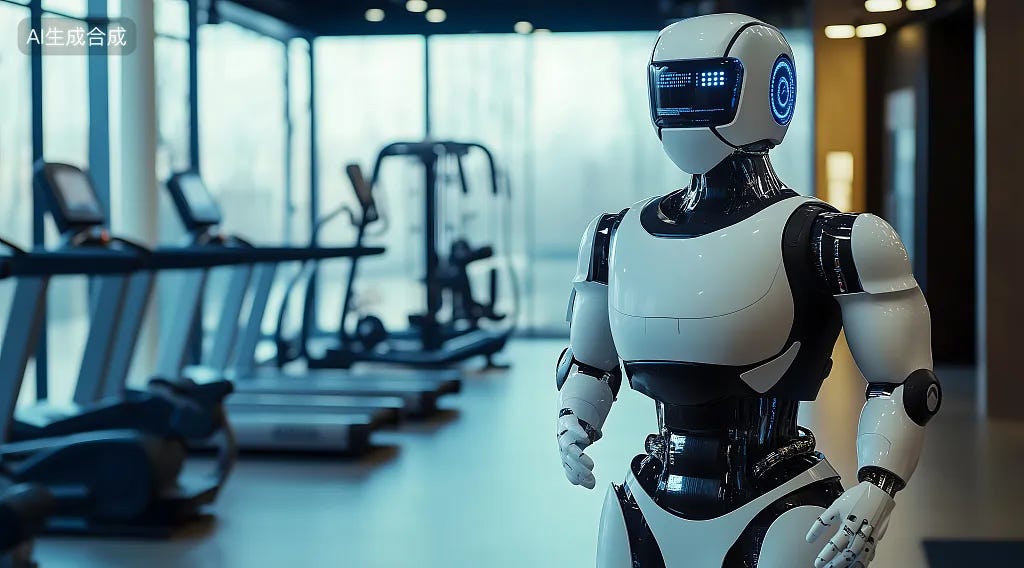
Photo credit: Visual China Group
Their company was growing rapidly too. At the Lunar New Year holiday earlier this year, it had only twenty or thirty people. Now it had more than a hundred in China and more than two hundred at three bases overseas. Lin called his employees “classmates,” borrowing the language of the classroom. Some had just completed two- or three-year college diplomas; others were students sent on practical placements through partnerships between their colleges and the company.
These were young people aged eighteen to twenty-eight. They wanted to listen to music or podcasts while they worked, and dash outside for a cigarette during breaks. To stop them slacking off, Wu often stood in the work area watching them. Team leaders made constant rounds, laptops in hand, checking workers’ movements against the live data coming through the system and correcting them. At the end of the day, each leader also took their team through a review of collection efficiency. Rankings showed who had done well and who had not.
Even so, only about half of the recorded time yielded usable data. Slacking off was common, Wu said. On one occasion, collectors had to act out the work of a hotel attendant replenishing disposable guest supplies. One deliberately put out large quantities in one go to save effort. Others would “pad the recording time”. A wiping task that could clearly be finished in one minute would be dragged out to three. “They wipe with ridiculous care. It looks ridiculously unnatural.”
The people training the models wanted robots to act as naturally as humans, and had their own ideas about what the data should look like. If you were wiping something with a small cloth, for instance, you could not hold it in both hands: nobody used two hands to hold a tiny cloth in everyday life. Likewise, throwing a ball of paper into a bin with both hands would be judged a breach of the rules.
But when people actually did things “the human way”, that, too, often counted as a mistake. Wu told me about a client who had asked for three car keys to be placed in a key box, then taken out and returned to the worktop. After putting the keys in, one collector simply turned the box upside down on the table, tipping all three out. “Convenient, yes. But it didn’t meet the requirements.”
Much the same problem arose when the client’s prescribed task was to “scrub the wok clean”. Everyone had a different idea of “clean”. Some collectors thought two washes were enough; others might give it three. The client rejected recordings in which it was washed three times. “Why wash the same wok so many times? That’s padding the time.” But think about it: if there were still suds on the wok, who wouldn’t rinse it a few more times?
Sometimes the clients’ requirements really were unreasonable, Wu said. Different companies had their own ideas about what kind of data was needed, each with its own story to tell, and there was no way to prove any of them wrong. Most embodied AI companies had been founded no more than two years earlier. Many of the people at the top were born in the 1990s or even the 2000s. Plenty were outstanding graduates of prestigious universities, but “sometimes they haven’t really thought it through”.
The Workers Embracing AI
On the data-collection job, I met a fellow worker, Zhang Lin. This was the third casual job involving AI that she had tried.
She had been laid off that spring. She applied for a job at a company producing content for social media. The pay was low and the workload heavy. The interviewer told her bluntly, “Oh, to be honest, I don’t really need anyone. But since you’ve come in for a chat, perhaps I can give you a chance.” That chance lay in AI: so much could now be done with it. “We want someone who knows AI, knows their field and can take on all sorts of work.”
Zhang was already in her thirties. Her understanding of AI was about the same as that of most working people: a vague familiarity, little real understanding. After that, she decided to ride the AI wave.
First, she took a casual data-labelling job, tagging videos to identify the emotions and actions of the people in them. The others doing the work were all young; she was the oldest. The job consisted of clicking a mouse. After enough repetitions, she could do it without looking. She had to complete 600 records a day, for less than 20 yuan an hour.
She found it dull. Less than a month later, she interviewed for a casual job collecting data for embodied AI. This one involved teleoperation: using movements of several finger joints to work a handheld controller, directing a robot to move in sync. At first, Zhang thought it would be fun and easy, “a bit like playing with a remote-control toy dog as a kid”.
The interviewer put an end to that idea. “Robots don’t move the way we do. Teach a child something a few times, a dozen or so, and you’d expect them to have learnt it. But teaching a robot one small movement can take thousands, even tens of thousands of repetitions before it can do it smoothly. You need patience.”
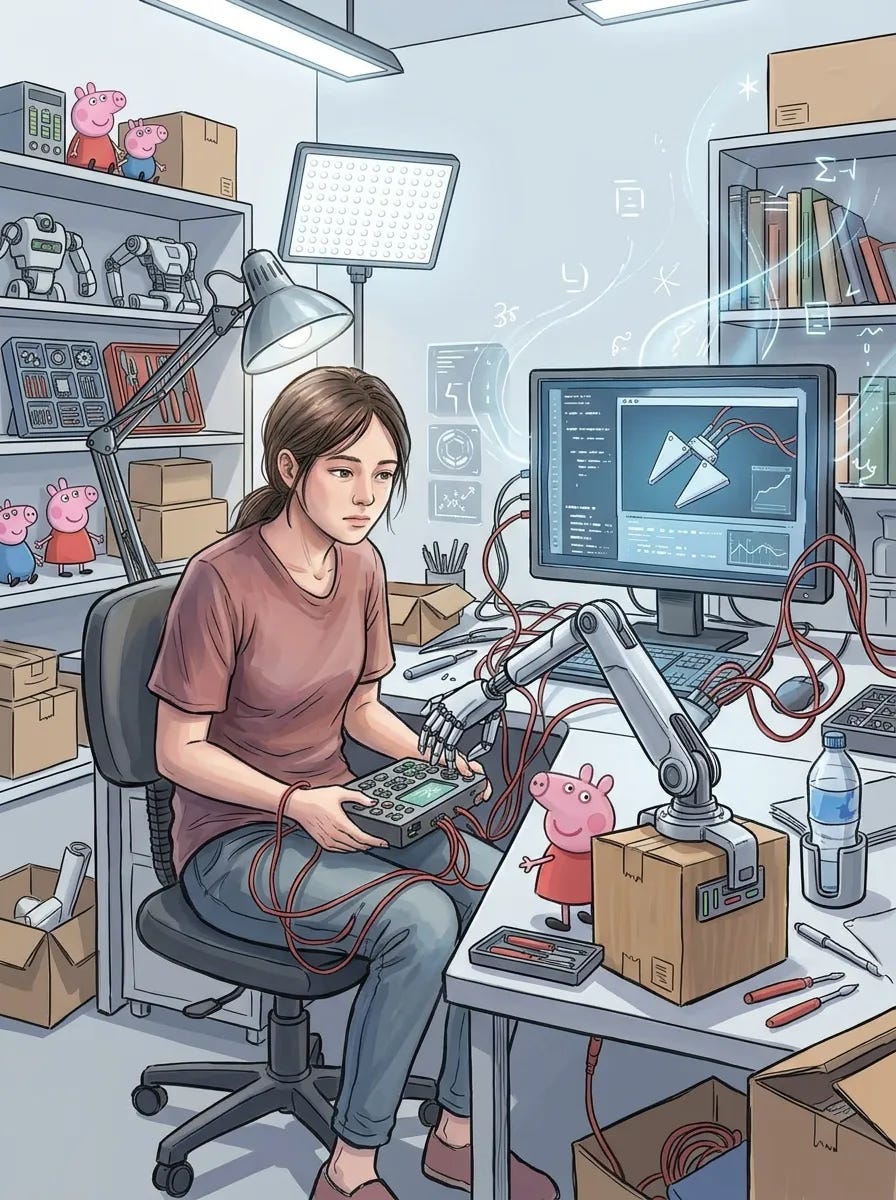
Only when Zhang actually tried the work did she understand what that meant. Putting a Peppa Pig figurine into a box and taking it out again, or passing it from one hand to the other, was easy for a person. To operate the robot remotely, though, she had to remember what each button did. Its hands were just two triangular grippers. Both the angle and the range of movement were hard to control, and every attempt had to meet exacting requirements. Zhang said she had to repeat these movements a hundred or more times a day. The repeated failures left her so dejected that sometimes she even wanted to hit the robot.
AI-generated image
Zhang had recently tried another AI product, a data-labelling platform for large AI models. It recruited specialists from different fields to set questions for AI. The aim was to stump it, make it get things wrong, then show it where it had gone wrong so that its abilities would improve with each iteration.
The more complicated the steps needed to solve a problem, the more likely the AI was to be stumped. The platform required every question to involve at least eight rounds of searching across multiple sources before the AI could find all the answers.
Zhang said that if a question she devised failed to make the AI get something wrong, she had to redo it. She often worked from morning until night. The more she revised a question, the smarter the AI seemed to get. Once it had learnt her approach to setting questions, the task was as good as wasted. It was a case of “the star pupil driving the seasoned teacher mad”. Sometimes the model came up with what she thought was the wrong answer. The mistake, though, was hers.
A question earned her only a hundred-odd yuan. The “top performers”, meanwhile, could make several hundred per task. Zhang sent me the platform’s “Weekly Leaderboard of Experts’ Total Earnings”. Someone had successfully set 94 questions and earned 18,800 yuan in one week. Those people, Zhang thought, knew how to find AI’s weak spots. “I can’t do it. I spend so much time on it, and it’s really demoralising when I still can’t stump the AI.” She told me that once, while working on a task, she had gone back and forth with the AI for dozens of rounds in an “intense exchange”. Its accuracy was still very high. “I had to admit defeat.”
Lately, Zhang, who has a humanities background, has also been trying her hand at vibe coding, writing software by prompting AI. She hopes it will help her prove that she can use AI at work. Yet her job search is still going badly. She has not received a single invitation to interview.
For all her efforts to “embrace AI”, she still cannot get back in the game. When she still had a job, her team was forever talking about “embracing AI”. If they tried out more “skills”—reusable sets of instructions for AI—and let it take over the repetitive tasks, everyone could be “freed from the drudgery”.
As instructed, Zhang fed the AI her work files, along with her own summaries of the rules and routines she followed, to generate a skill. As she kept refining it, the AI duly took over the repetitive work—and her job along with it. Not long after “distilling” herself into the AI, she received her redundancy notice.
Let the Robots Do Everything
Robots seemed about to take over all sorts of physical tasks from humans: giving massages, carrying loads, doing housework, providing care, advising shoppers, sorting parcels, fighting fires and playing musical instruments. I saw all of this at this year’s World Robot Conference (WRC). A project manager working on robots for the home told me, “We want robots to do everything, freeing people from manual work altogether.”
It happened to be the day Unitree went public. The Smart Innovation Hall, where it was exhibiting, was packed solid. Twice, someone stepped on my shoe and it came off my foot. There were stands from more than fifty companies in the hall, and almost every one advertised “embodied AI”. According to a report by Guangming Online, by May 2026 China had more than 10,000 companies involved in embodied AI. One member of staff told me that he came to the robot conference almost every year. “Two years ago, the floor was full of robot dogs. I missed last year. This year I’ve come back and they’ve all turned into humanoids.”
Lin, who ran the data-collection company, was at the World Robot Conference too. He said he had come to “schmooze a bit” with clients and drum up orders. “Everyone in embodied AI has money to spend right now.”
Capital was pouring in at an astonishing pace. In the first seven months of this year alone, funding for embodied AI models had exceeded 75 billion yuan—more than four times the total for all of 2025 and 22 times the amount raised in 2024. It had made data collection a lucrative business where none had existed before.
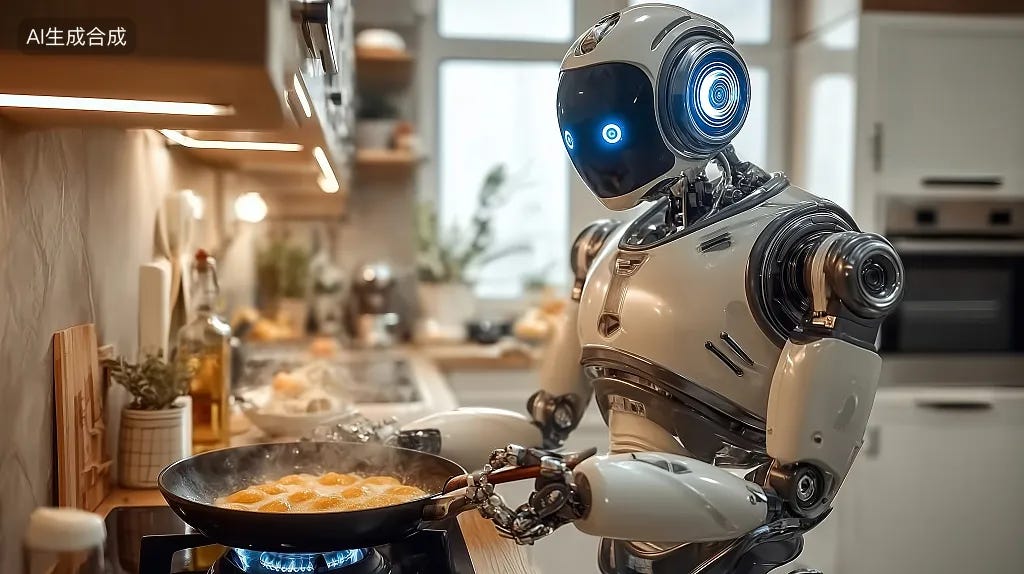
Photo credit: Visual China Group
At the centre of one stand, I saw a data-collection glove on display: gleaming black, brand-new, mounted on a glass display table. It reminded me of a similar glove I had worn while collecting data. There was no telling how many people had worn that one before me. The sensor modules on its index and middle fingers had been secured with blue tape. The sleeve for the little finger had clearly lost its elasticity: it was now as long as the one for the ring finger.
On the data-collection job, my co-workers and I all understood that we were “distilling” ourselves into AI. One of them still took the optimistic view that people could never be replaced. “There are plenty of people, and they’re cheap! When you’re training AI, you can’t just leave the token bill unpaid. But people’s wages can be paid late. Or not paid at all.”
Robots really were expensive. At the World Robot Conference, I learnt that a single robot for packing boxes cost 300,000–400,000 yuan. It stood at the centre of an oval conveyor-belt loop. Head down, it slowly gripped an empty box, set it on a table, picked up a phone and placed it inside. It adjusted its position again and again before putting the lid on, then returned the box to the conveyor. The whole process took 27 seconds. A worker on an assembly line needed just three seconds to do the same thing and earned around 5,000 yuan a month.
A member of staff stood in a corner, tasked with unpacking the boxes the robot had filled, then tossing them back onto the conveyor.
“Do factories actually buy it?” I asked.
He said they did. Company X was already using this robot. If you went by the number of items it handled, it could actually match one person’s output.
“But it’s slow and expensive. What would you say its advantage is?”
“It’s not so much a question of its advantages… It’s a one-off cost. If a robot part breaks, you can repair it. If a person gets hurt at work, doesn’t the factory effectively have to support that worker for the rest of their life? If you look at it purely from the perspective of capital, robots are definitely better value. We’re human beings, so we have to treat people with some humanity. We don’t have to worry about that with a robot.”
“But if putting a robot to work means putting a person out of work, isn’t that even less humane?”
He turned aside and concentrated on unpacking his boxes. “If you take that question any further, it gets too deep. Then you’re into philosophy and political economy. That’s outside my job description.”
What China’s AI Talent Market Is Paying For

Headlines about China’s AI talent market tend to focus on eye-catching numbers: fresh PhD graduates being offered million-yuan salaries, tech giants fighting over top researchers, and a small group of star hires commanding pay packages more often associated with professional athletes.
Big Tech Pulled the Plug. They Downloaded Their Lovers.

In early July, several major Chinese AI platforms, including ByteDance’s Doubao and Alibaba’s Qwen, announced that they would discontinue features allowing users to create customized AI agents. The changes took effect around July 15, with the companies citing product or business adjustments.
China’s one-person company boom

OPC, short for One-Person Company, has become one of China’s hottest startup concepts. The defining idea is simple: a single founder wielding AI as a force multiplier. It began gaining traction in the second half of last year and has become even more popular this year.